 To break the popular resistance to freedom, it is first necessary to understand the factors influencing public opinion.

The freer a society, the greater its potential for wealth and human flourishing. This was obvious during Europe’s Belle Époque, but is it possible to rediscover this truth? There is an aching need for more freedom both politically and economically. Yet, statism - the belief in an extensive role for the state in society - has prevailed in the battle of ideas, and most people therefore seem unable to recognize that many of the crises now engulfing Europe are the product of decades of illiberal policies and state interventionism.
Statism as the Prevailing Political Opinion
What many believe are external shocks or isolated policy failures are, in fact, deep but predictable dilemmas inherent in the socialist-interventionist welfare model that has halted growth, reduced investment and now, inevitably, stirred up society. This confusion about the causes of Europe’s woes is worrying because it will prevent the election of candidates with programs of reform and freedom, thereby exacerbating the crisis. But at the same time, this confusion is not surprising, considering the prevailing media propaganda and mandatory public education that have promoted statism for generations.
The majority generally holds opinions based on convenience rather than conviction. People say they love freedom, but they do not actually support political and economic freedom today, because it long ago ceased to be the “conventional wisdom”. The majority now supports statism out of habit, not from a strong ideological conviction in the moral necessity of an expansive state, as true socialists do, but because this position aligns with the prevailing orthodoxy. The wealth of Western societies accumulated during a less statist era, despite the destructive world wars, allowed statist and socialist policies to continue for decades, carried by voters.

Between Majority Tyranny and Minority Rule
The statist stance of the average, apolitical person is, therefore, rarely ideological; it is merely a useful ad hoc position in his or her personal and professional life. There is a clear advantage to blending in and thereby avoiding the ostracism produced by what J. S. Mill termed the “tyranny of the majority”.
This obedience is especially pronounced among those who feel, or truly are, close to economic or political power. Individuals near the centres of political or corporate decision-making, driven by personal ambition, are frequently the most loyal “lieutenants.” They go to great lengths to fall in line, to suppress any inchoate opinions they may have held and instead adopt the views of their superiors and the class to which they aspire.
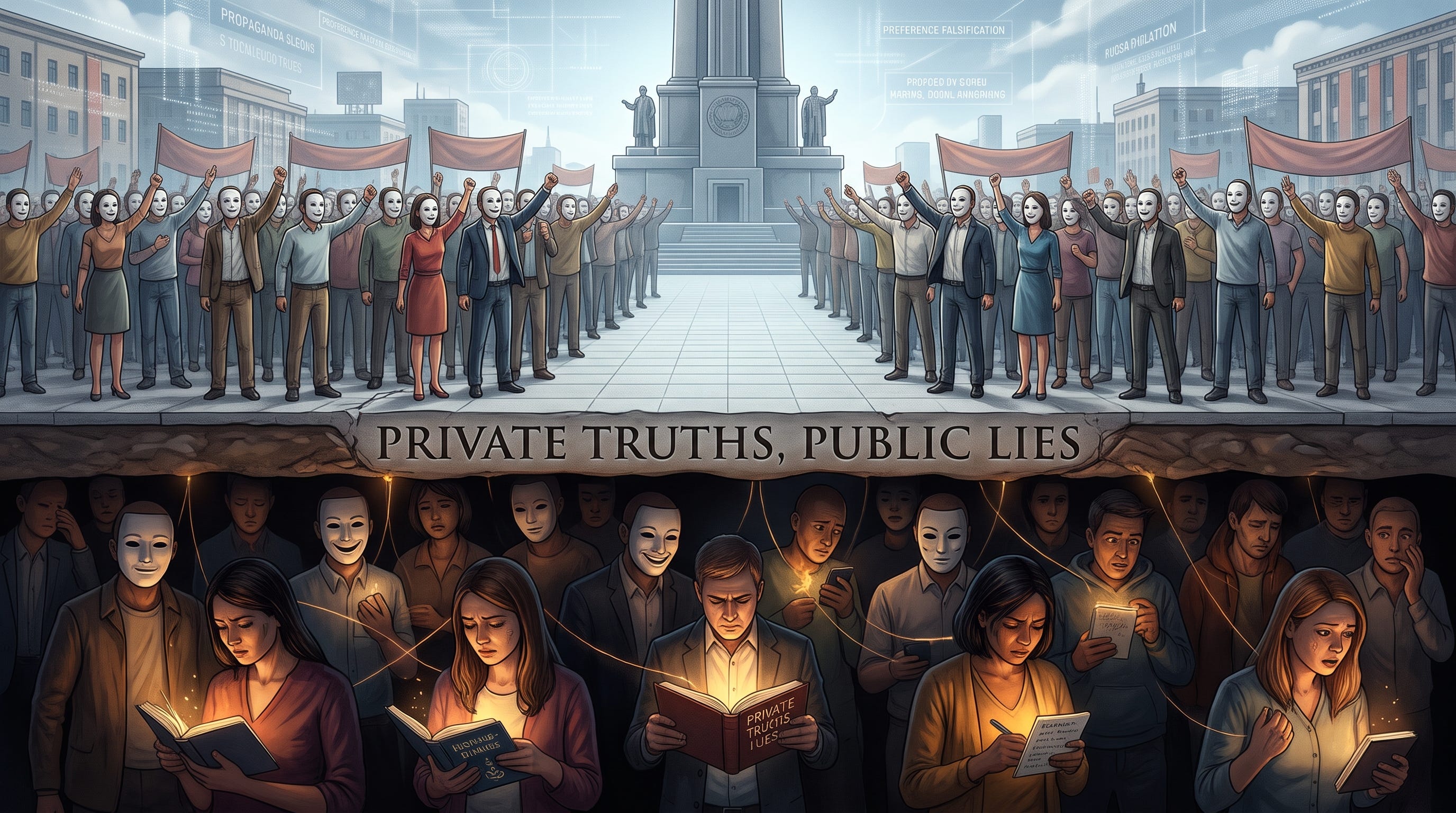
Certain individuals do not fall easily for propaganda. As Timur Kuran explained in “Private Truths, Public Lies” (1995), when individuals do not share prevailing opinions, social pressure often prevents their dissident or minority views from being voiced in public or social settings. In such contexts, socially ambitious individuals develop an instinctive grasp for which opinions are implicitly “approved”. They generally do not express such minority views outside their private sphere or, when it is impossible to avoid expressing such “unapproved” or heterodox opinions, resort to lying in public.
Most people are thus unknowingly caught between a rock and a hard place: “cornered by the Many, controlled by the Few”, unconsciously conforming to the majority in order to gain acceptance, while unwittingly following the guidance of the ruling minority. Regarding the latter guidance, it is still not widely accepted that public opinion in the West, in particular regarding “sensitive” questions, is influenced or directed by propaganda efforts from the “molders of opinion”.
Can Opinion-Molders Support Freedom?
The opinions that exist at any given time in society are too important to be left onto themselves, especially in so-called representative “democracies.” As Albert Camus said, echoing Gaetano Mosca:
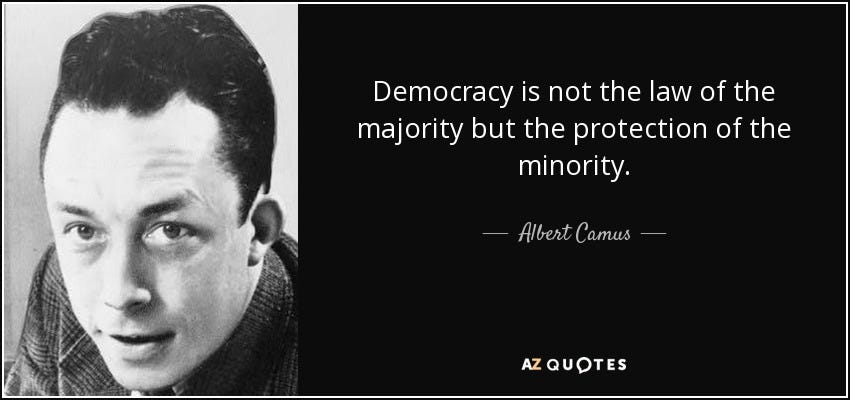
Ruling minorities naturally want to have a say since their power rests on public opinion. Edward Bernays wrote in his classic, “Propaganda” (1928),
“We are governed, our minds are molded, our tastes formed, our ideas suggested, largely by men we have never heard of.”
Everything from opinions about politics and economics to tastes in art, fashion and travel is largely influenced by a relatively small group of people. They hold key positions in business, academia, the arts, government institutions and non-profit organizations. They are university deans and professors of the humanities and economics; media owners and news editors; leaders of think tanks; fashion influencers and celebrated artists; management and innovation experts. Government agencies, notoriously the CIA, are also for obvious reasons deeply involved in trying to mould public opinion, with success it must be said, going as far as to impact the values of society themselves. As Walter Lippman wrote in “Public Opinion”, (1922)
"The creation of consent is not a new art. It is a very old one which was supposed to have died out with the appearance of democracy... But it has not died out. It has, in fact, improved enormously in technique, because it is now based on analysis rather than on rule of thumb."
Though public opinion can be directed over the long term, crises are often used as opportunities in this respect. To take a few examples where crises are manipulated or exaggerated to great effect: ruling minority indicates that Covid-19 lockdowns are “necessary” and “good”, then so they are. If the mRNA-unvaccinated are considered “bad”, wind farms “good” and Russia “bad”, so it is. If statism is the accepted form of social organization, so it shall be.

Indeed, if public opinion is to change regarding attitudes to freedom, then those who influence public opinion should change their current acceptance of statism. The idea of freedom can gain acceptance among the majority more easily if some of these moulders of opinion break with the ranks of the ruling minority on this question.
More Resistance to Freedom
The resistance to ideas of freedom is not only social, however; it is also intellectual, because the free market is less easily understood when state interventionism is taken as the norm. The straightforward argument of “laissez-faire, laissez-passer”, classical liberalism’s rallying cry, rarely convinces in a firmly statist society. Instead, statist interventionism is now an emotionally satisfying, yet intellectually lazy, economically inefficient and morally unjust “solution” to social “problems”.
Embracing ideas of freedom requires a more theoretical understanding of society and the function of the market. This is of course a weakness for ideas of freedom, in comparison with socialism which is said to “come from the heart”. Embracing freedom requires accepting that actual outcomes of a state policy for a specific group may differ from the intended outcomes.
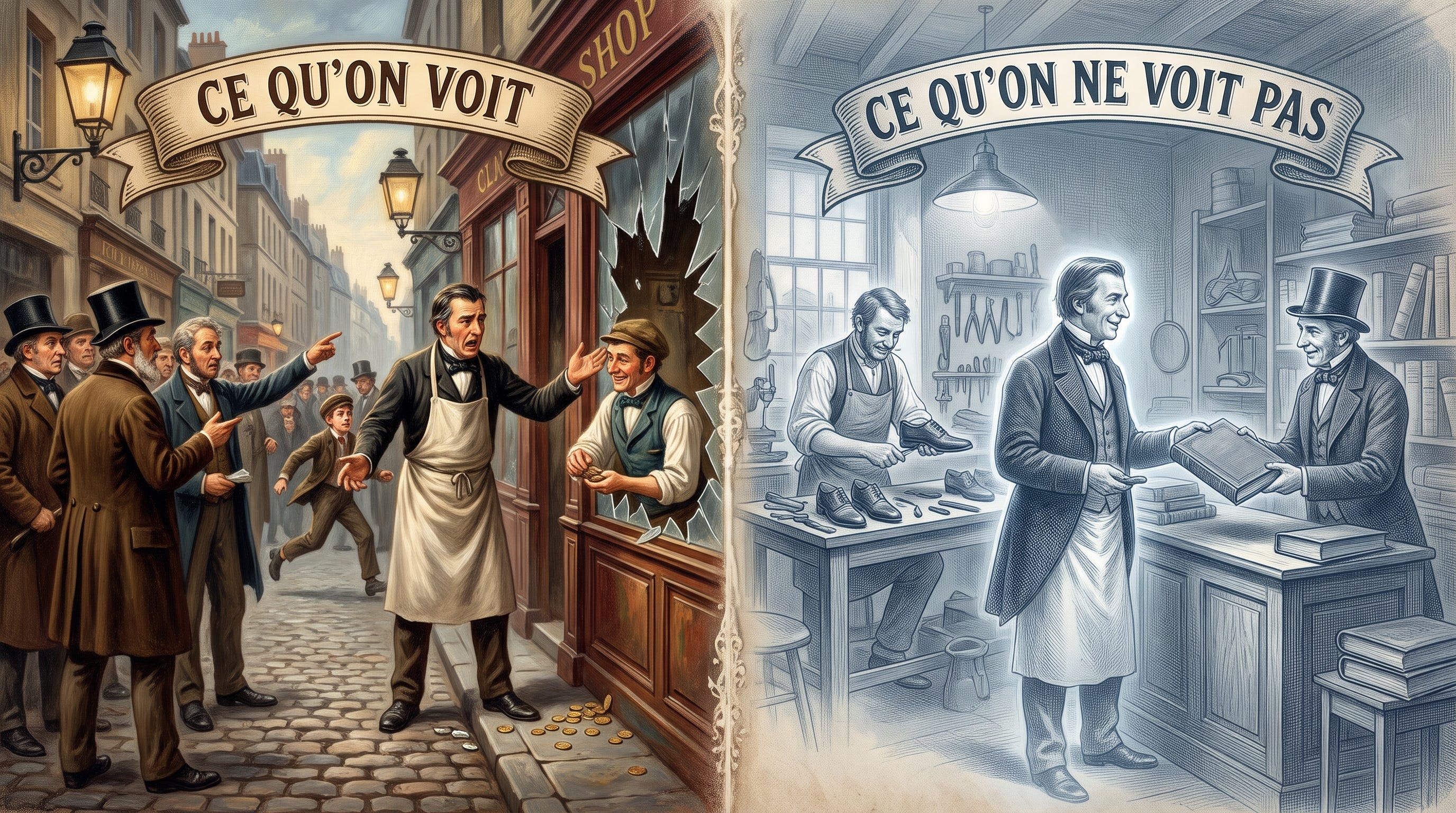
To reject the core tenets of statism - such as wealth redistribution, social “justice”, or monetary inflation – it is necessary to grasp the principle of “externalities”: the real-world impact of such policies on groups that were not their intended targets. Perhaps most challenging is opportunity cost: to imagine the alternative outcomes across society had a particular policy not been implemented. This is the realm of “that which is not seen,” to paraphrase Frédéric Bastiat’s famous phrase, as illustrated below.
Further, studies have suggested that individual political orientation is associated not only with social and cultural influences, but also with measurable differences in cognitive style and even brain structure. Thomas Sowell approached this from a different perspective in “A Conflict of Visions” (1987), arguing that persistent political divisions ultimately reflect fundamentally different conceptions of human nature and the possibilities of social organization.
While this can naturally feel frustrating for those who defend freedom and wish to convince people to give up their statist ways, the above also presents an opportunity: if political opinions are often held merely as a matter of convenience, and if the public opinion can be relatively easily swayed to and fro by propaganda, then these opinions are not firmly fixed in people’s minds and could therefore be replaced with ideas of liberty. The road to freedom will be long, but it must start with a recognition of the mechanisms that prevent ideas of freedom from taking root in society.
No comments:
Post a Comment