
It has been clear for some time that France will end in crisis. The protests across the country on the Saturdays of October 17 and 24 sparked a new political dynamic in France and set off a perfect storm in Europe. The level of looting and destruction of private property was unprecedented in living memory.
But what was also shocking was the French government’s reaction during these events of Oct. 17 and their aftermath, or rather, its lack of reaction. Indeed, the handling of security during much of the protests raises a serious question: is this a question of gross state incompetence or Machiavellian “raison d’état”?
The Authorities Had Foreknowledge
The date of Oct. 17 had been circulating on social media as a day of mass demonstration since the first half of September. The French authorities responsible for policing must have known this. Yet, President Macron said that they had been unprepared:
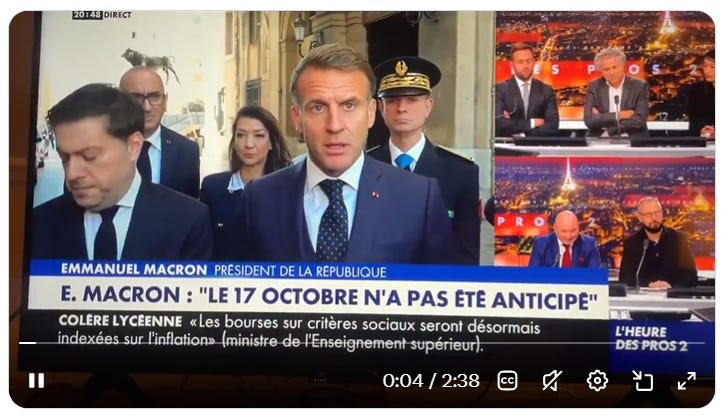
Indeed, the level of “unpreparedness” during that fateful day is unbelievable. On Oct. 17, 30,000 looters raided Marseille alone, according to its Prefecture, yet the law enforcement that was present seemed passive, as the well-connected newspaper, Le Canard Enchaîné, noted:

How can this happen in a state with over a quarter of a million police officers? It seems a mere 10,000 law enforcement officers were deployed across France (from a total of about 275,000 national and municipal police officers and gendarmes) on Oct. 17. This is a suspiciously small number, as Macron’s disgraced former chief of security noted:

This anomaly becomes even more suspicious when one considers the obvious “double standard” at play: on the one hand, ruthless and disproportionate violence directed at unarmed high school students just a couple of weeks earlier. On the other hand, law enforcement seemed inexplicably restrained when faced with gangs of methodical looters. There are many signs that the police were strangely passive or even taking part in the violence, possibly even helping to instigate it.
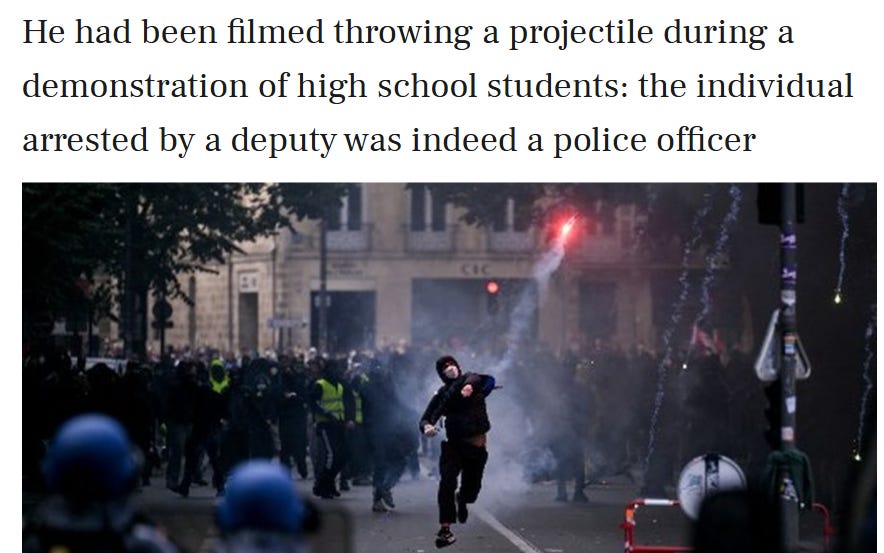
Aftermath of the Protests
Some speculation is unavoidable in this case. The question to ask is, of course, “cui bono”? There can be an interest in using “security” as a pretext for control over a volatile situation and a restive population. The mobs of looters on Oct. 17 were underestimated according to the government, yet the government then reacts by strengthen its repressive arsenal, such as a state of emergency, restrictions on the right to demonstrate, the introduction of facial recognition, and restrictions on social media.
Most, if not all, of these policies were mentioned positively by many mainstream politicians on both sides of the spectrum in the days after the event. But if it were simply a question of having failed to prepare, then why are these measures even being talked about?
Macron gave one clue when he said on Oct. 19: “Social media is damaging our democracy.”. He has long seen social networks as a political threat that needs neutralizing, but was thwarted by the French Constitution Council in Aug. 2026.
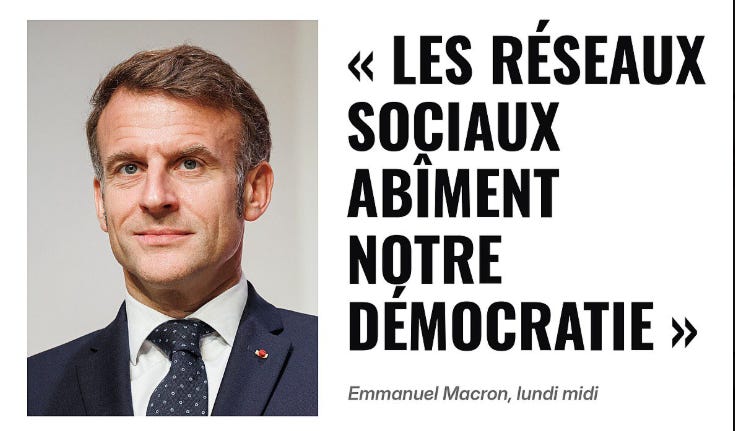
As if on cue, Prime Minister Lecornu expressed his wish to have the power to block social networks directly at the level of the French telecom operators:

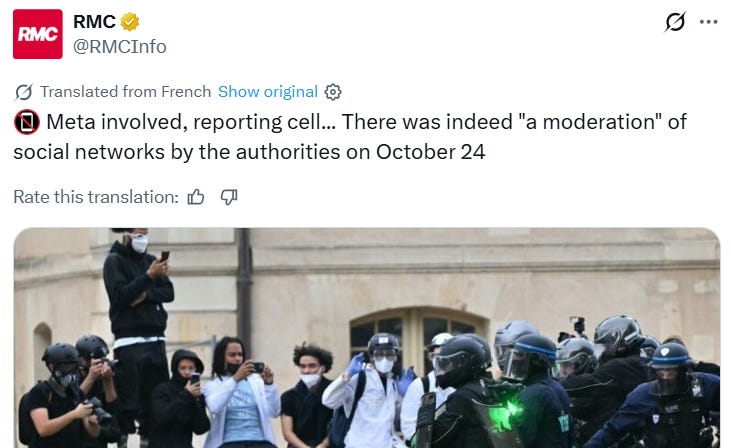
For the huge, mostly peaceful demonstrations of Oct. 24, there was, at a minimum, an attempt by the government to “moderate” the relevant social networks. As French state radio, Franceinfo, confirms:
Is this enhanced moderation a response by social media platforms to a government request, as many posts suggest? A meeting did, in fact, take place at Matignon on Friday, October 23, with representatives from Meta, Snap, TikTok, Reddit, Discord, and Google, aimed at “better preventing the dissemination of illicit content that incites violence, property damage, and looting,” according to a statement from the Prime Minister’s office.
Considering all this, it is no surprise that on Oct. 28, the French Senate adopted at first reading a government-backed amendment that would significantly expand the state’s powers to order the removal of online content. The key parts are the following:
“[...] in response to the incitement—even if it does not lead to any actual act—to commit offenses, the administrative authority may request the removal of content [...] when such content is likely to cause a serious disturbance to public order [...]”
“Failure to remove content [...] within twenty-four hours [...] is punishable by six months’ imprisonment and a fine of 150,000 euros.” “The amount of the fine may be increased to up to 2% of the entity’s total worldwide turnover, excluding taxes [...]”
“If the content is not removed, the administrative authority may request that the sites be blocked and delisted.”
The amendment effectively shifts the policing of online speech from the judiciary to administrative authorities and private platforms. Content deemed manifestly unlawful can be ordered removed within 24 hours, while hosting providers face severe penalties for non-compliance and websites may ultimately be blocked or delisted. Faced with such risks, platforms have every incentive to censor first and ask legal questions later.
More wheels of state control are are set in motion as well, since just before the demonstrations of Oct. 31, the police authorities simply explained that a latest prefectural decree allows them to use drones for mass surveillance:

Technologies to Control More
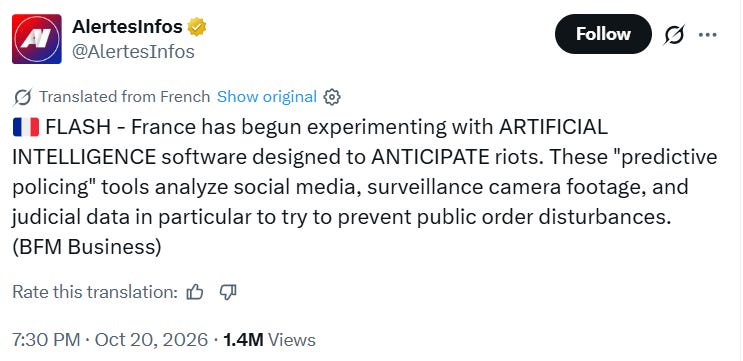
But much more sophisticated technologies, of which the young protesters are largely unaware, are being rolled out in order to control the riots and identify perpetrators even when they are masked:
Algorithmic video surveillance, automated social-media scraping to identify warning signs, and the consolidation of biometric and judicial databases.
[Security startups] are now flooding the European market with these turnkey solutions, driven by a calculation of chilling clarity: the social crisis is structural, economic insecurity is taking root, and the struggle to make ends meet will inevitably become more acute.
When the cost of living explodes, protest becomes the norm. Faced with that equation, European governments increasingly turn to their remaining instrument of control: algorithmic policing. (@BetterCallMedhi)
Political Speculation and “Raison d’État”
Taken together, these developments make it difficult to avoid the conclusion that there is a Machiavellian willingness within the French political establishment to assert control and use the protests to its advantage, despite the fact that its own disastrous policies of recent decades are largely responsible for today’s popular reaction, especially among the young.
Firstly, the government plan seems to be to accept the violent protests and let them erupt, in order to create a new political reality that will allow them, according to their twisted logic, to preserve power in the next high-stakes presidential election (April 2027). Possibly, this is a (failed) attempt to pin the chaos on LFI (Mélenchon’s party).
Secondly, the goal could be to stir up these protests in order to justify crackdowns so as to preserve the rule of law and, in fact, institute and normalize far more draconian measures, like those listed above.
French ex-Senator Yves Pozzo di Borgo stated that the severity of the protests due to lack of security was going to be an excuse for President Macron to trigger Article 16 of the French Constitution, which allows the President to concentrate executive power in his hands, in the event of a national emergency. This is a theory that now has a lot of traction in France. Art. 16 states:
When the institutions of the Republic, the independence of the Nation, the integrity of its territory, or the fulfillment of its international commitments are under serious and immediate threat, and the regular functioning of the constitutional public authorities has been interrupted, the President of the Republic shall take the measures required by these circumstances, following official consultation with the Prime Minister, the Presidents of the Houses of Parliament, and the Constitutional Council.

This is an interesting theory, but it seems early for that if the goal is to annul the presidential elections. Moreover, it seems difficult to argue with any seriousness that the conditions set out in Article 16 have been met in this case. Last but not least, Macron probably has greater international ambitions after ten years as President of France.
Conclusions
What has been suggested above should not be too shocking or impossible to believe. It is part of the classic methods of the state to increase power over society at a time of extreme popular tension, possibly provoked by that same state. An example of this kind of pressure policy involving the state was the Years of Lead (Anni di piombo) in Italy during the 1970s and 1980s, showing the tension between political violence and the temptation to expand state powers in response to it.
Another more recent and even more relevant example is the Patriot Act; the extra powers to the US Government that sailed through Congress a month after the attacks of 9/11, 2001. Indeed, the parallel between this amendment in France and the Patriot Act in the US is obvious: in both cases, the promise of greater security provides the rationale for expanding state powers that, once established, are difficult to revoke. More than two decades later, significant parts of the Patriot Act remain embedded in American law. France, like other so-called “liberal democracies,” is on the road towards authoritarianism, and the events of October 2026 will likely be seen in retrospect as an important step in that direction.
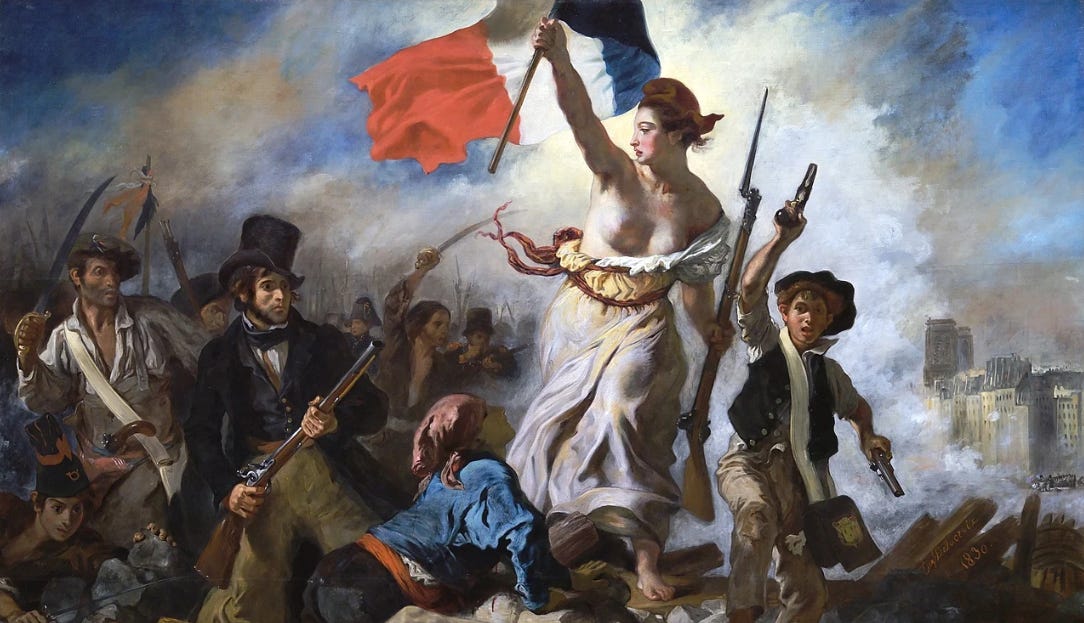
Regardless of the extent of the French authorities’ involvement, they are playing with fire here, even just through their refusal to contemplate any serious reform in France. There are inherent risks in such strategies, of course, since no one can predict how this will end politically once it has been unleashed. The political conscience of the French people has stirred.
No comments:
Post a Comment