
As many have understood, freedom of speech is under threat in the West today, in particular - of course - dissident speech. But it is important to remember that even if freedom of speech protection were implemented for speech that threatens the power-that-be, public opinion would still be corralled and controlled by the ruling minority. And public opinion would still be subdued by its own conduit: the majority. In other words, public opinion - that most important of political agents, capable to bringing down entire political systems - is cornered by the many and controlled by the few. This is what makes politics truths so difficult to spread in society.
Russia and China Themes as Examples
In the West, certain themes are difficult to question without running the risk of receiving sharp pushback. There is a position considered “correct” by Western collective opinion, regarding “climate change”, the “multicultural society”, the “pandemic response”, etc. It is implied that the “acceptable” position to each one of these themes can and should be adopted by society without any prior critical analysis at the individual level. The same is true of course outside the West, but it is that West that is trying to mould the world.
The list of these “sensitive” topics is not static; new ones wax while others wane as their political importance passes. In recent years two new themes have emerged: “China” and “Russia”, which is not surprising since Washington, and thus, by extension, the West, decided to treat these two nations as strategic enemies. A recent study shows that in a very short time the percentage of Americans with a negative view of China increased dramatically, from 46% to 67%. This is not a coincidence, of course, since the majority of Americans are blank slates with regard to China. Another study come to following key findings:

As far as Russia is concerned, the “correct” attitude to have in the West, especially since the start of the Ukraine conflict on February 24th 2022, is no less than an absolute condemnation and even “cancellation” of that country, although this was untenable in the medium term. Support for Ukraine must be comprehensive and the award for this stance is social acceptance and confirmation, even though that position will hurt economically those who hold it. Historical facts are not part of the equation.
The antiwar position always faces headwind in the West because it is never the position promoted by the war-mongering state and mainstream media. “Rallying around the flag” is what is sought by those who attempt to influence public opinion. Nationalist fervour has often been easy to rouse, as the following example shows:
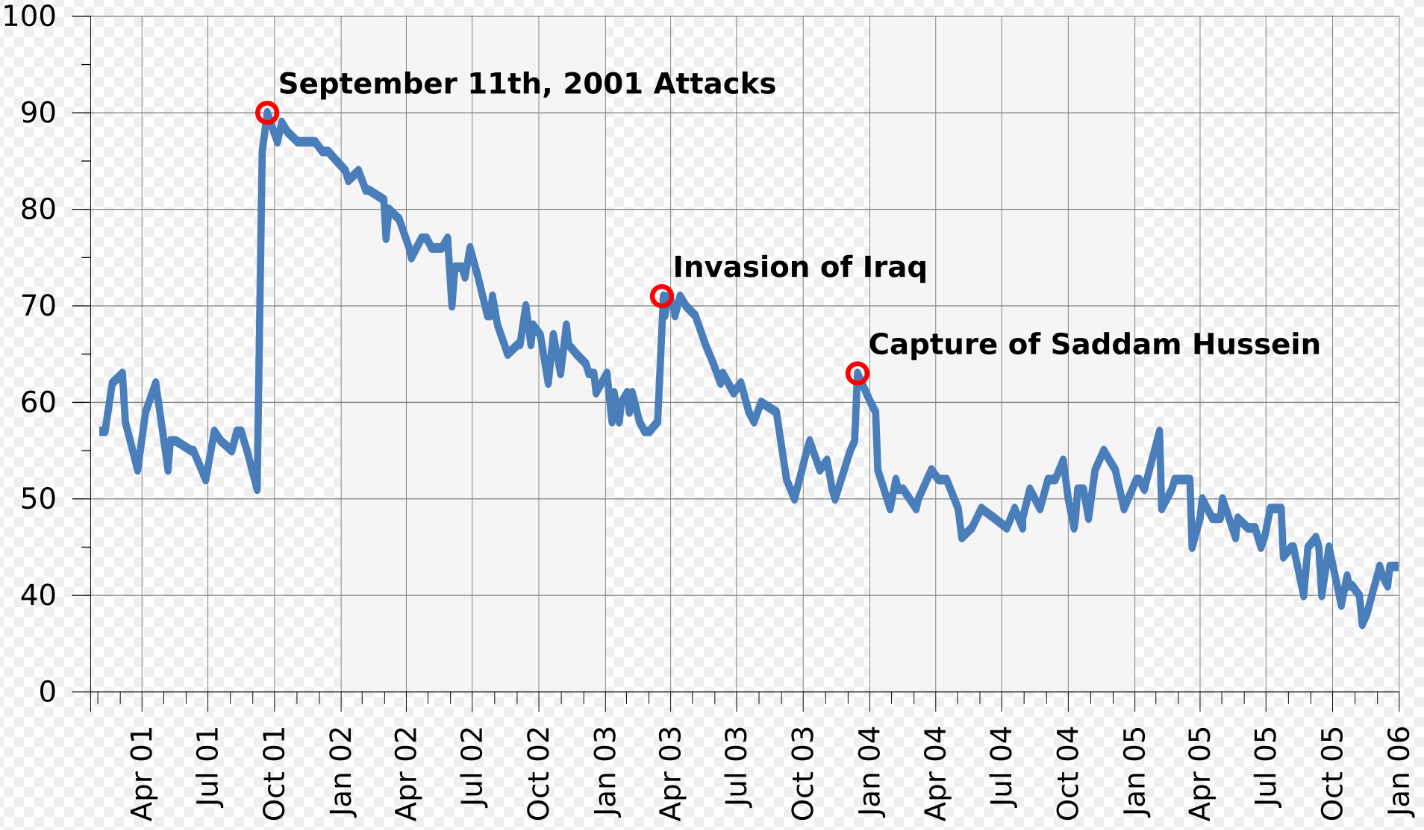
At a minimum, the majority will not spontaneously reject war actively and firmly on moral grounds, because of a natural lack of empathy and because of the influence of the media machine, though this influence has of course become weaker with the advent of social media (for how long?).
Between Tyranny of Majority and Ruling Minority
What is happening in these examples above is not surprising or new. In his famous work, On Liberty (1859), John Stuart Mill gave his prescient early warning of the dangers of “collective opinion“; the “tyranny of the majority“ in the form of “the dominant opinions and feelings that society is trying to impose“ on a minority. The majority is constantly reining in and directing public opinion, like a herd shepherding itself.
Society’s majority is naturally intolerant of non-conformism, because thinking like everyone else gives psychological comfort and strengthens social ties. Thus, people often tell lies in public, to hide their dissenting opinions, they keep the truths for the private sphere. This is what Turkish thinker Timur Kuran called “preference falsification” in his well-known work, Public Lies, Private Truths.
Yet, though society depends on collective opinion for its social cohesion, paradoxically, it also depends for its well-being on views that run counter to this majority opinion. Just as natural science progresses only through the sometimes critical but generally respectful process of peer review, society grows with minority opinions and dissident voices that temper the permanent search for consensus by the majority. As Herbert Marcuse wrote in his essay “Repressive Tolerance” (1963), the plural, tolerant society would need to counter-intuitively realize the following:
“the realization of the objective of tolerance would call for intolerance toward prevailing policies, attitudes, opinions, and the extension of tolerance to policies, attitudes, and opinions which are outlawed or suppressed.”
Indeed, unpopular opinions and politically sensitive facts are suppressed also by the majority, if there is no wider understanding of Marcuse’s point. This happens even if these opinions are correct, and often, especially if they are correct. Fortunately, this understanding could exist today, if the majority just cared to inform itself in what should be its own self-interest.
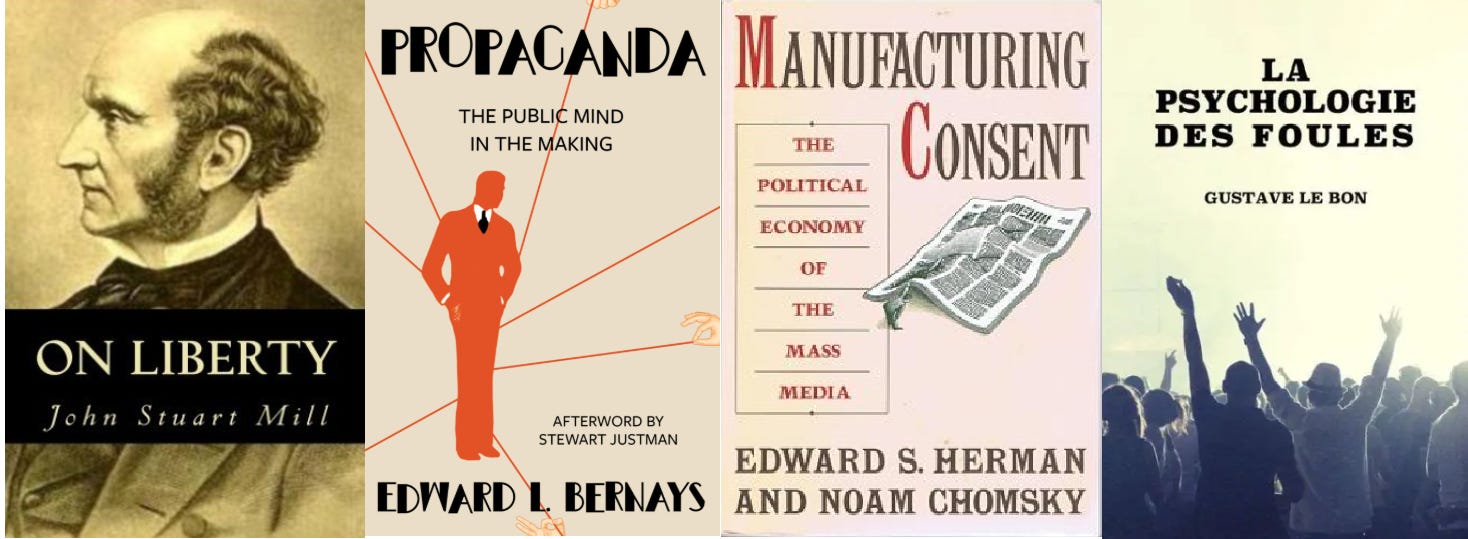
There is a whole literature that can allow the public to awaken; it could massively influence attitudes towards the ruling minority. To Mill’s “collective opinion“ were added the following concepts over time:
“Crowd psychology” by Gustave Le Bon (1895), which is key to understanding public opinion.
“Political formula”, coined by Gaetano Mosca (1923), i.e. the ideologies or narratives that justify the ruling minority (e.g., democracy, nationalism, etc).
“Propaganda” by Edward Bernays (1928), which explores the means that the ruling minority can and do use to shape public opinion.
In “Intellectuals and Socialism“ (1949), F. A. Hayek identified “second-hand dealers in ideas" (journalists, academics, pundits), acting as gatekeepers of political power.
In Brave New World Revisited (1958), A. Huxley warned against the technical means the powers-that-be use to get public compliance.
In the Manufacturing of Consent (1988), N. Chomsky and E. S. Herman explain how dissenting opinions are throttled unwittingly even by consenting journalists.
Mass Formation Psychosis is a recent book by Matthias Desmet which revisits many of these earlier themes.
There is thus a large accumulated body of knowledge that leaves no doubt about the will and the ability of the ruling minority to form and direct public opinion through the control that it exerts explicitly and implicitly on public school curricula and on editorial boards of traditional media and on social media platforms. The evolution of the opinions of Western majorities to the great political topics of the day, is largely the result of this minority’s influence on Western public opinion. Climate change policy is probably the most shocking result of this influence recently, considering the negative economic consequences that it is having.
Political globalization, an anti-liberal process which has been underway for several decades, has the effect of aligning national political centers and thus reducing plurality. Gradually, Western political power flows towards supranational institutions (like the UN and the EU). This centralization of political power, and the resulting economic concentration of business, including the concentration of media groups, enables and facilitates the formation of public opinion by the Western ruling minorities.
Calling on Freedom
Freedom is the antidote to these trends, and the political philosophy that theoretically is best placed to solve this dilemma of modern society is arguably libertarianism. It clearly argues for a significant and definitive reduction of political power, both nationally and internationally.
One of the strengths of libertarianism is precisely the importance it places on the cultural and intellectual plurality of a free society. This is the famous “marketplace of ideas” which, like the free market in goods and services, cannot exist fully, in the context of the pervasive crony capitalism, mainstream media spin, and massive state intervention to which today’s societies are subjected. In a free society, that is, in a highly decentralized society with a weak state having at most a nightwatchman role, public opinion cannot be steered.
The present moment in History represents a particular difficulty for freedom, because the ruling Western globalist minority not only feels threatened by the rise of external powers, but it has unprecedented digital tools for mass psychological management at its disposal, in order to shape attitudes and opinions. Crisis is always seen as opportunity by those who wield political power. At the same time, the new and easy access by the public to alternative analyses and independent information, can counteract this nefarious trend. This democratization of information via independent media has made the ruling minority deeply insecure.
In these political and social conditions, voices of freedom must continue to explain how public opinion is cornered by the many and controlled by the few: it is influenced not only by the ruling minority but also by the tyranny of the majority. The current period sorely needs a rallying cry for freedom in West, because the screws of state coercion are likely to keep on tightening unless there is serious resistance.
No comments:
Post a Comment