
Welcome to the EUSSR
In
early 2025, US Vice President J.D. Vance warned Europeans of “old, entrenched
interests hiding behind ugly, Soviet-era words like “misinformation” and
“disinformation,” Though this is clearly a case of the pot calling the
kettle black, there is undoubtedly some truth
to this,
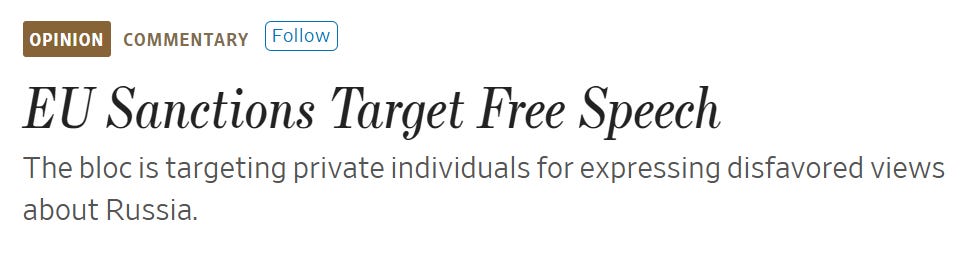
as the EU has been turning the screws ever tighter on freedom of speech.
Soon
EU samizdat?
Then,
a few months later while visiting Moldova, President Macron stressed that “the EU is in no way the
Soviet Union.” This comment didn’t come out of nowhere: such a remarkable
and unnecessary denial by the French president is full of meaning, at a time
when the “EUSSR” meme is becoming increasingly popular. In fact, a comparison
between the EU and the USSR is not unwarranted. True, Europe is far wealthier
and more capitalistic than the Soviet Union ever was. But politically the
parallels exist, which is why the term EUSSR is now so often being thrown
around to describe the inefficient, corrupt and centralized EU administration.
It
is important to note though that these similarities are not just a coincidence.
In EUSSR: The Soviet Roots of European
Integration (2004),
authors V. Bukovsky and P. Stroilov exposed, with declassified archives in
Moscow, “the secretive discussions between Western and Soviet Union leaders
planning to create a collectivist European Union State.” A top priority for
the USSR in order to counter the United States’ influence in Europe was to try
to bring Western Europe, through an enhanced EU, closer to a reformed Soviet
model. The Soviet leadership under M. Gorbachev introduced the socialist concept
of a “Common European Home“ which was to include Western
Europe, the Warsaw pact countries, and of course, a reformed USSR.
The
booklet shows that this idea was fully embraced by many Western European
socialist leaders at the time, like President F. Mitterrand of France, and Prime Minister F.
González
of Spain, who discussed the matter directly with M. Gorbachev in Moscow.
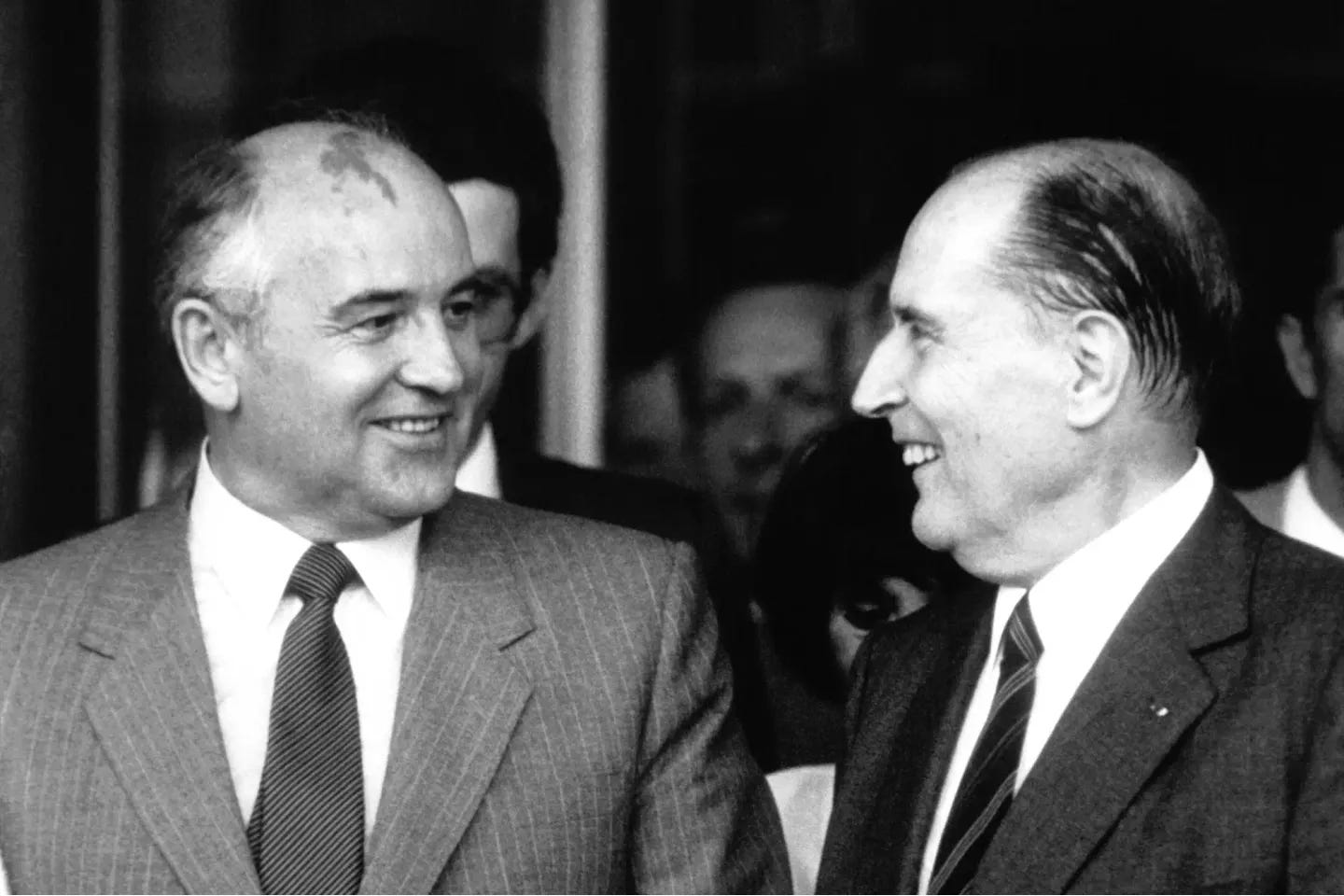
Gorbachev
receives French President Mitterrand in Moscow on July 9, 1986.
Not
surprisingly, both Mitterrand and González strongly favored further European
integration at the expense of nation-states; they not only were proponents of
the Maastricht Treaty (signed 1992), but also two of its most influential
architects and advocates within the European Council. In a meeting with Spanish
Foreign Minister Ordóñez in March 3, 1989, Gorbachev said:
“Through our perestroika, through
the new ideas brought forward by the socialists of Western Europe, we are not
moving away from each other, we are doing the opposite.”
The
idea was that the political and economic “restructuring” of the Soviet Union,
meant to stop its decline, would align economically and ideologically with the
future EU. Considering this context, it is not surprising that the European
Union of today recalls the late Soviet Union in many respects. As the authors
wrote:
“For anyone
even remotely familiar with the Soviet system, its similarity with the
developing structures of the European Union (EU), with its governing philosophy
and “democratic deficit”, its endemic corruption and bureaucratic ineptitude is
striking.”
Towards the Collectivist EU State
The
“European Union” is the technocratic administration centered in Bruxelles
(European Commission and Council) and Strasbourg (European Parliament) together
with only semi-independent national states, tied together in a symbiotic power
relationship, including currency stability from the ECB and redistribution
between states, regions, and sectors. In the same vein, the USSR was composed
of the administrative apparatus centered in Moscow (Council of Ministers,
Gosplan, Central Committee of CPSU) together with nominally sovereign Socialist
Republics, involving credit allocation from Gosbank and redistribution between
republics, autonomous regions, and industrial sectors.
The
political and administrative similarities between the EU and the USSR are
indeed striking, and even more so today than in 2004. Economically, Europe also
does far too much planning from the center than healthy societies need. Though
it has a much bigger private sector than the Soviet Union had, the growing size
of EU’s public sectors, unsustainable state debts and pressure from fiscal
jackboots
are clearly weighing on European economies in ways that strongly remind of the
stagnation of the late USSR.
The
EU is following in the Soviet Union’s footsteps in that it also prioritizes
political ideology and regulatory control, rather than free markets and
laissez-faire. The EU’s energy
policy
is a good example : there is an almost sectarian fervor to it (“the
science is settled!”), demanding decarbonization while disregarding science,
competition, and cost, and with a deeply rooted dislike of Russia. As Bruxelles
is coming under ever more pressure, it is also becoming more disconnected with
existing economic and social realities, just like the Soviet leadership.

It’s an obsession.
Europe
is starting to suffer from the same centralization sickness as the Soviet
Union; with the center too incompetent and too disinterested to really
represent and defend the interests of European peoples. Indeed, the EU’s
political architecture seems to be moving towards the USSR’s organizational
concept of “democratic centralism”. As Alberto Mingardi, Director of
Istituto Bruno Leoni, writes:
“The drive to transfer ever more
sovereignty from diverse member states to Brussels is turning the European
Union into an inefficient, centralized nation-state construct.
“Hence, the
EU is supposed to grow through crises and thanks to crises: whatever the problem or issue, it
could foster a slice of national sovereignty to be cut and brought up to a
higher level.”
Mingardi
hints at the fact that external causes are falsely painted as culprits for the
EU’s current predicament, just like the Soviet Union tried to blame decay on
the “Global Capitalist System” and the “Arms Race”. In the EU these “crises”
also serve as excuses to enhance societal control; globalization, Covid-19,
Russia, USA, China, global warming, immigration, and so on.
Further,
just like the USSR’s Council of Ministers, the EU Commission is composed of
large unelected bureaucracies (32000 civil servants…); both are
unaccountable bodies that hold the true power over the legislative process.
Even the EU titles have strong similarities with the
USSR, as “Commissioners could be called “ministers of the EU” and the
Directorates-General of the Commission, “ministries””. There is a sham
parliament in both cases; the EU Parliament resembles the Supreme Soviet in
that it exists primarily to “rubber-stamp” decisions made by the executive
bureaucracy rather than represent the people. The “EU Commission’s drift
towards authoritarianism” is unmistakable today.
Few
would deny that the EU now also has a Soviet-style “nomenklatura”; a new class
of “Eurocrats” which also enjoys legal immunity, high salaries, and privileges that
separate them from the general population.
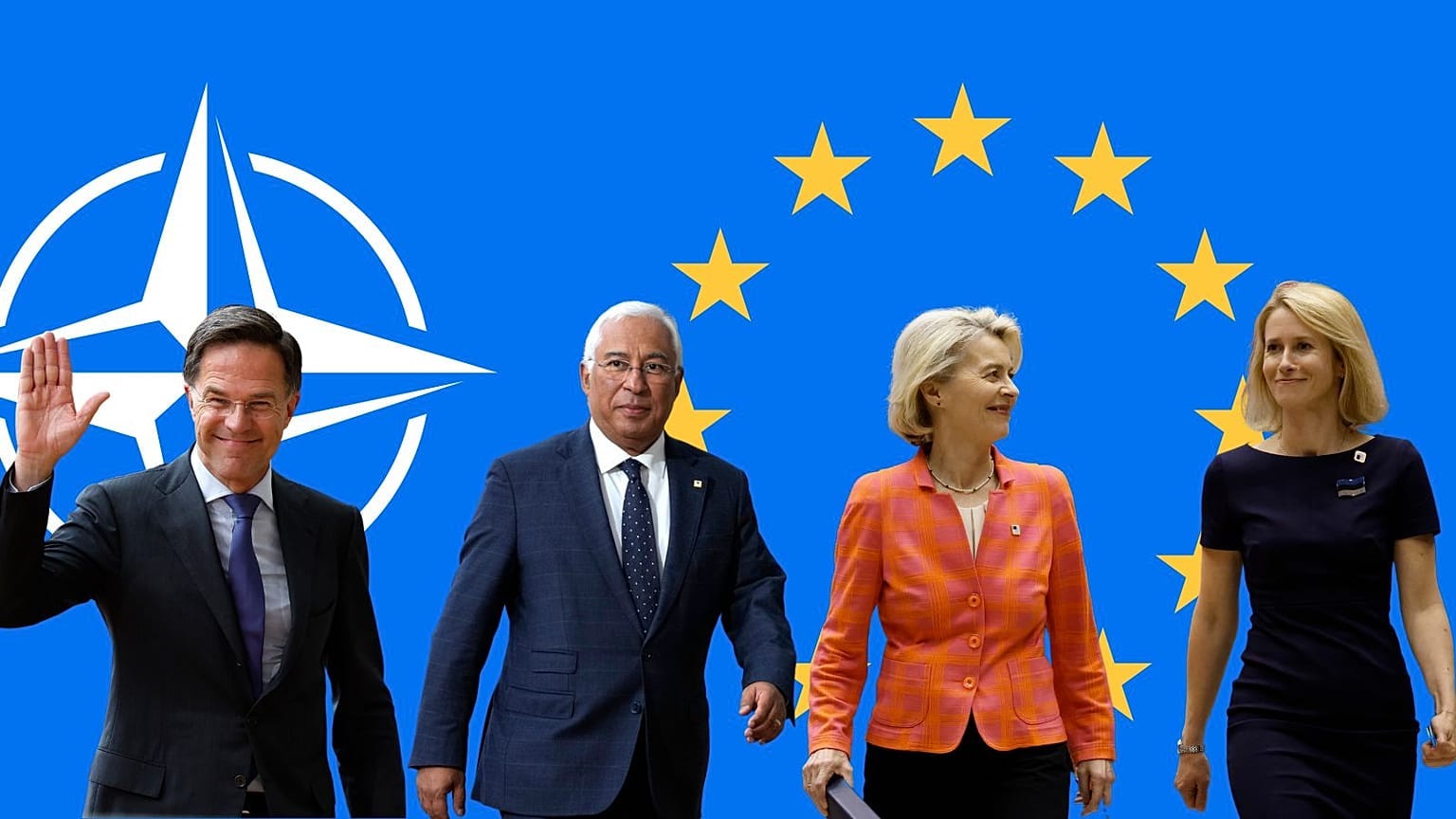
The
heads of the EU nomenklatura
The
ever-closer cooperation between the EU and NATO also resembles the USSR, where
the military and the civilian economies were not easily distinguishable. The
EU, and in particular Germany, is moving in this direction as “defense”
expenditures are exploding, using the Ukraine conflict as a pretext.
Euronews
reports that “defense” spending is
increasing dramatically in the EU:
“Using 2024
constant prices, EU defence spending was €234.2bn in 2020. It rose to €343.2bn
in 2024 and is expected to reach €381bn in 2025. The real increase over the
past decade, from 2015 to 2025, is 99%. In 2014, spending was at its
lowest level in real terms at €188.5bn.”
Expansion and Collapse of the EU Project?
The
examples above show that in many ways the EU is moving towards the kind of
Soviet model that was planned had the USSR not collapsed. This is part of a
general trend across the Western world that has been on-going for several
years, to increase statist technocratic control of society in all areas; public
opinion (restrictions on freedom of speech), private property (CBDC for public financing of government debt and control
dissent), and even physical movement (digital health pass, carbon
restrictions). Ironically, this is part of the globalist plan of the Western
financial oligarchy.
Most
citizens would probably reject this obvious restriction of freedom. In the
future, there will of course be public opposition to these plans; the question
is when and how widespread this popular opposition will be. In order for the
ruled majority to express firmly its opposition to such an evolution, it must
first become largely aware of it. Therefore, information and education about
what the European Union (including its mostly compliant national governments)
is morphing into is key. If anything, this nefarious statist development of the
EU is accelerating rather than slowing down. It is therefore urgent to move now
to stop the further “sovietization” of the European Union, and return to simply
upholding the principles of Four
Freedoms,
if the supranational EU structure cannot be dismantled entirely.
Hopefully,
it will be possible to count on EU hubris, corruption, administrative
disorganization and bureaucratic incompetence, all of which are inevitable with
every attempt at centralizing political power. Therefore, just like the
Communist experiment that collapsed in Russia, there is also a possibility that
the future “sovietized” EU could experience the same fate. With the current
incompetent EU leadership, this possibility has probably increased of late. As
the authors of “EUSSR” wrote, but with perhaps too much assurance:
“The EU will
continue to expand uncontrollably, unable to stop, until it collapses in
exhaustion pretty much like the late Soviet Union.”
The
problem in Europe is that political awareness does not exist yet with the
majority of Europeans. Until (if) such an awareness crystalizes, there is thus
no vigorous public pressure that could oppose the EU’s plans for further
integration. This lack of understanding can partly be explained by the European
bourgeoisie’s mostly business-oriented attitude, lacking much political
consciousness. But it is also a result of successful propaganda efforts
undertaken over decades by corporate media and state institutions to align the
public with the EU agenda. As Howard Zinn warned:
“the dominant powers in society prefer
that knowledge be used only to maintain the status quo, to train young people
to take their obedient places in the existing society rather than challenging
the people in power.”
This
has been going on for so long now that, contrary to the Soviet people,
relatively few Europeans have realized yet that their freedoms are being eroded
and that their beloved democratic systems are failing. The tragedy is
that by the time they wake up, it could be too late.
No comments:
Post a Comment