
The recently FoIA released Bush-Putin verbatim transcripts provide interesting insights into US-Russia relations during the presidency of George W. Bush. Considering the on-going tragedy in Ukraine, the details of the meeting between Bush and Putin in Sochi, Russia on April 6, 2008 is of particular historical interest.
Short Background to the Sochi Meeting
President Putin had been expressing more and more clearly Russia’s opposition to further NATO enlargement to Ukraine as well as Georgia., after the 2004 wave which brought seven new countries into the military alliance. Putin made Russia’s position crystal clear in front of US foreign policymakers during his now (in)famous 2007 Munich Security Conference speech (in which “Ukraine” is mentioned 32 times…)
The fateful NATO Summit in Bucharest took place from April 2 to 4, 2008. Leading up to it, France and Germany, supported by several other Western government, were clear and vocal in their opposition to giving Ukraine and Georgia a path to NATO membership. And on April 1, 2008, a day before the summit began:
“Ukrainian movement toward [NATO] membership would trigger a deep crisis in Russia-Ukraine relations and would impact upon European security as a whole,” Grigory Karasin, State Secretary of Russia’s Ministry of Foreign Affairs, warned.
Yet, completely disregarding Europe and Russia’s prescient concerns, Bush insisted on setting Ukraine and Georgia officially on the path to membership (MAP) by unanimous vote during this Summit. A few days later, on April 6th, 2008, Bush and Putin met in Sochi, as per the newly declassified verbatim exchanges:
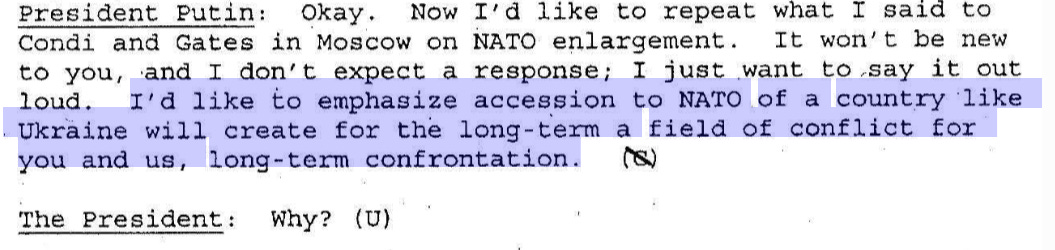
Putin’s premonition about the future is eerily correct. Bush’s answer is obviously feigned ignorance after all the exchanges regarding Ukraine’s NATO accession path in 2007 and 2008, and all the warnings, disagreements and explanations given by the Russians just days before this Sochi summit. Thus, Putin knew Bush was being disingenuous, but once again warned that NATO accession of Ukraine is dangerous, not only for Russia, but for Ukraine itself.
“Russians” in an Artificial Ukraine
This danger is related to Ukraine’s composition. It was important for Putin to dismiss, then as much as now, the idea that Ukraine is a relatively homogenous unitary state. This was never the case. Putin went on to clarify that Ukraine is (or was…) a heterogenous, divided and artificial nation-state:
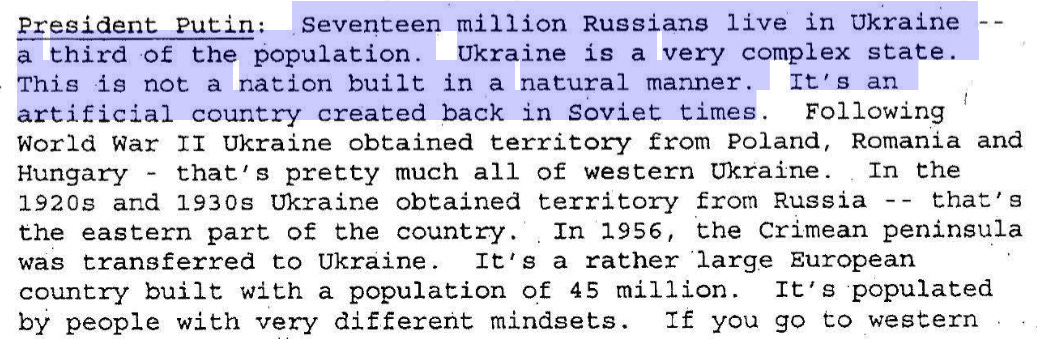
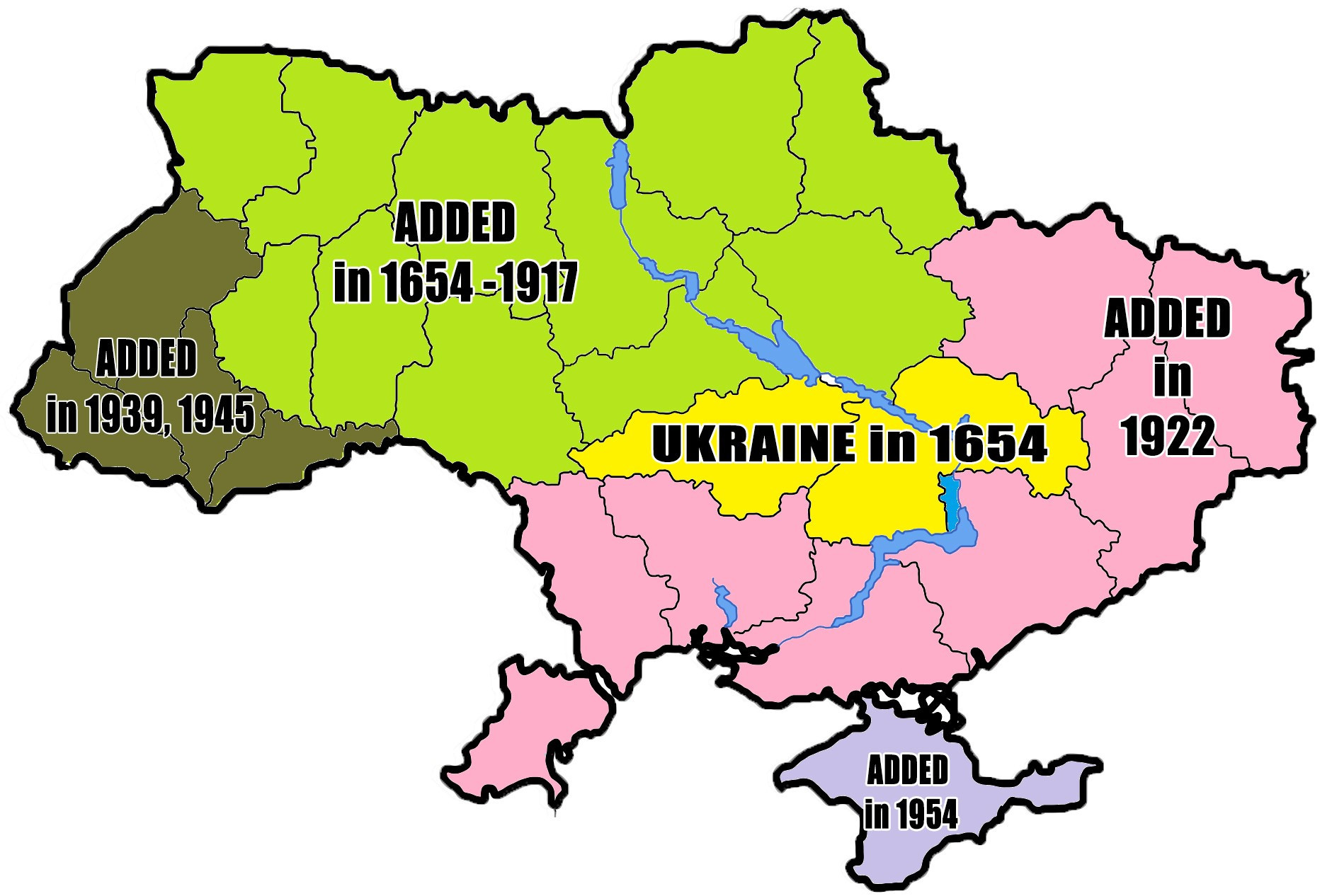
Russia regretted ceding thousands of square kilometers of historical Russian land to Ukraine, but accepted the current situation, despite the millions of “Russians” living in Ukraine. But Putin goes on to explain that Ukraine was a nation whose delicate balance between the West and Russia should not be disturbed politically. Because of the demographic, cultural and religious “split” in Ukraine due to its recent political construction, NATO enlargement in view of bringing it closer to the West would destabilize it if the population was not in favor of it (thus actually opening the door for NATO in the long term):
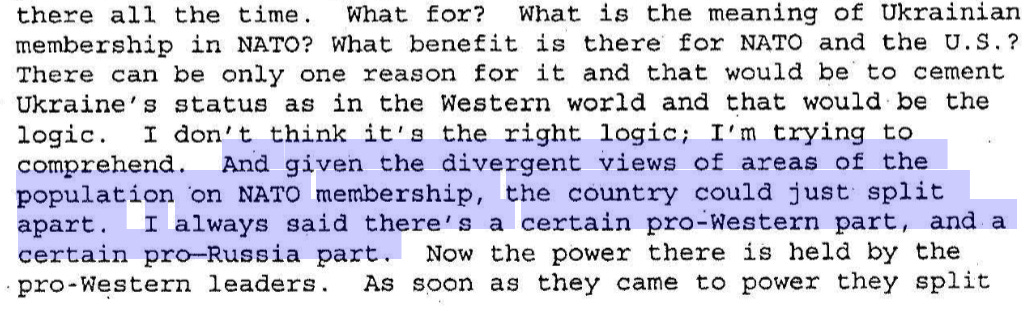
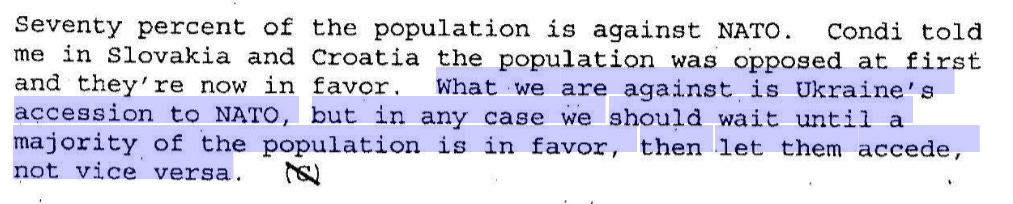
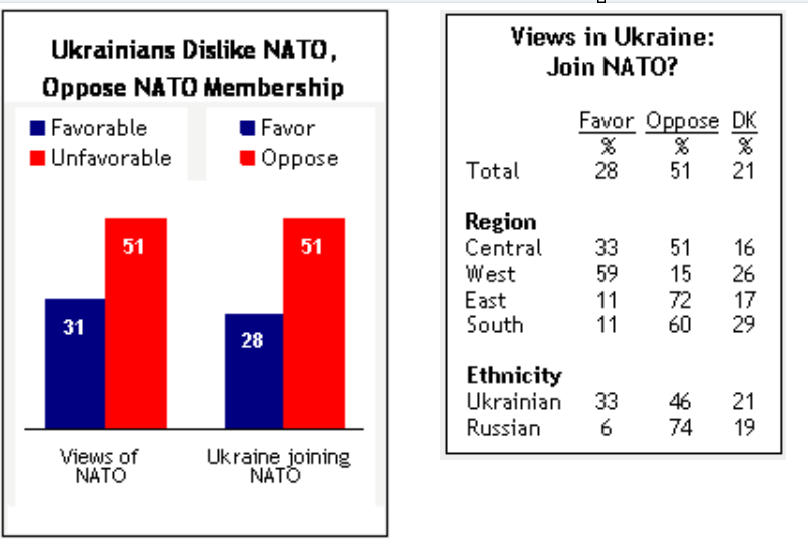
Indeed, as late as 2010, a majority of Ukrainians were still against NATO membership. The West-East split and the “ethnic” divergence were also clear in 2010:
Finally, it is noteworthy that throughout this exchange, only Putin is talking, making the effort - again - to explain to Bush why Russia is against Ukraine’s accession to NATO. But Bush, who just days earlier had “convinced” all NATO members during the Bucharest Summit, including France and Germany, to vote in favor of Ukraine’s membership path (MAP) to NATO, just remained silent, unwilling to expose or explain his true position - the need for US hegemony.
Joint Press Conference on the Same Day
In the joint press conference later the same day (April 6, 2008), Putin answered the question of future NATO enlargement to Ukraine and Georgia in the following way:
“As far as NATO enlargement is concerned, we talked about it at length earlier today. I reaffirmed Russia’s position on this count. I believe that in order to improve relations with Russia it is necessary not to pull the former Soviet republics into political/military blocs, but to develop relations with Russia, itself. And then the actions of the bloc, of this or that issue, in a few years will not be perceived so acutely in this country [Russia], as is the case today.
As far as enlargement is concerned, technical enlargement of NATO, I believe that this is a policy which is in conformity with former, old logic, when Russia was perceived as an adversary, which is no longer the case today. As Churchill said, if you can’t change the subject it is a sign of radicalism.”
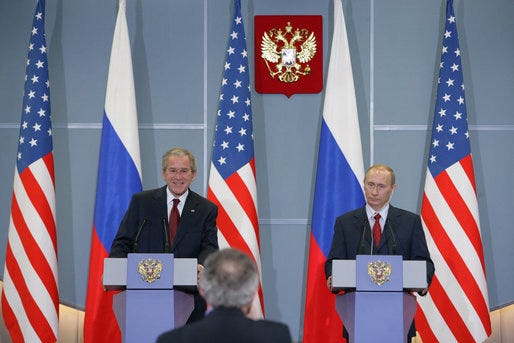
Putin here engaged in wishful thinking when he proposes for Russia to no longer be seen as an adversary by the US, because he must have known by that time, of the futility of such a wish. Yet, he points towards the natural solution, which is never an option for Washington: better relations and an increased understanding between Russia and the US.
Such a rapprochement could even have led, as Putin clearly hinted, to the Russian political elite eventually accepting a NATO membership for Ukraine, provided also the Ukrainian population was clearly in favor, also in the East. But that would have meant an improvement of relationship between the US and Russia, meaning that the whole purpose of NATO - confronting the USSR, then Russia - would be void. That is something of course that the US Military Industrial Complex could never accept.
Finally, all these efforts, proposals and warnings by Putin, not only on April 6, 2008 but before that and long after, fell on deaf ears. The US was adamant on bringing Ukraine into the Western fold as part of the Brzezinski idea to weaken Russia and take control of the “Heartland”. NATO membership for Ukraine was just one aspect to this global strategy, as the deep US involvement in Ukraine and in other countries around Russia since the 1990s demonstrate. Putin’s premonition in Sochi almost 18 years ago unfortunately proved correct.
No comments:
Post a Comment