
God knows Trump is flawed. When Putin was asked in 2024 whether he preferred Biden or Trump, he answered Biden for his predictability. Putin doesn’t understand unpredictable narcissists like Trump; who does? This partly explains some of Putin’s missteps in recent months with respect to Trump and the high-stakes diplomatic game going on between the two superpowers.
But the mistakes go back further in time and are not only related to Trump, but concern Putin’s relationship with the West generally. This is surprising since the Russian president comes across as a balanced, objective and historically-minded thinker; arguably the only real statesman worthy of the name in current times.
Naivety Regarding NATO
Russian has a weak spot for the West, and always have. Since Peter the Great, many educated Russians have wanted their country to turn to a “West” that they looked up to culturally and economically. This yearning continued even as the Iron Curtain separated them physically and ideologically.
This was epitomized in the trust that Mikhail Gorbachev and most of the Soviet political elite placed in US and Western promises, at the end of the Cold War, of not expanding NATO to the East - in return for a united Germany in NATO. As the late historian Hélène Carrère d’Encausse confirmed, Gorbachev naively thought that he was “dealing with gentlemen”. What a complete misreading of the Western political class…
But Putin and many other Russians politicians and analysts have shown similar naivety. He was sincere enough to actually admit it publicly in 2023:
“During an interview with Russian journalist Pavel Zarubin broadcast on Sunday, Putin conceded that he was a “naive” leader in the initial stages of his political career, despite his robust background in Soviet intelligence.”
The Russian leadership has even shown pride in the fact that Putin suggested Russia could join NATO in the early 2000s, not once but twice. Not surprisingly, this proposal was rudely laughed off by “Dubya” Bush, as being utterly ludicrous, one which could only have been made by someone who didn’t fully grasp NATO’s raison d’être.
Considering the aggressive role and expansive nature of NATO in the 1990s, not least in Ukraine itself, how could Moscow’s leadership have doubted NATO’s ultimate goal? A younger and inexperienced Putin may not have fully understood the original and constant purpose of NATO as an anti-Soviet and then anti-Russian coalition, though many, more cynical Russians did so in the 1990s, like Vladimir Zhirinovsky.
It is important to remember that this question of NATO membership happened at the same time as, according to what Putin himself has claimed on a number of occasions, Washington was allegedly trying to undermine Moscow by supporting the Chechen jihadis in the Second Chechen War (inside Russia). Yet, Putin actually excused this meddling to “inertia of thinking“ in the West, again misreading Washington’s real intentions with respect to Russia.
Putin’s Soft Spot for the West
Putin, like Stalin before him, clearly has a soft spot for the West, and in particular the US. This may have clouded his judgement with respect to Washington and made him forget what kind of mafia style foreign policy the US runs.
The reality is that Russia has let itself be hoodwinked for years, for instance by misreading, under the presidency of Dmitri Medvedev, the West’s intentions in Libya and thus not vetoing in the UN Security Council the NATO plan for regime change in that country.
Then came “events” organized specifically to discredit Russia. Flight MH17, shot down over Ukraine in 2014 and killing all 298 people on board, was very likely perpetrated by the Ukrainian military and covered up by the West. Then came the sordid Skripal and Navalny affairs in 2018 and 2020 respectively; the supposedly failed poisonings by “Novichok”, which certainly Russia was not responsible for, but that was used by British and US intelligence agencies to further isolate Russia and split her from the West. It worked, and Putin’s management of these two affairs inevitably leaves something to be desired.
Apart from expelling some US diplomats tit-for-tat, Russia remained largely silent, thus implicitly admitting guilt in the eyes of Western publics used to hysterical cries of protestation by anyone who is innocently accused. During this time, Putin decided that Russia would continue to meet regularly with Western political leaders at the G8 and within the Normandy format, as if everything was fine. The West was wrong to read weakness into this passivity, but Russia certainly had a role in inadvertently creating this image of itself.
Russia’s Ukraine Blunder
But the most consequential mistakes relate to Ukraine. Russia with Putin at the helm probably misjudged Western intentions in Ukraine first in 2004 and then in the 2014. Russia seems to have remained passive in 2004 during the “Orange revolution” in Kiev, in which Russian intelligence must have known about the involvement of CIA, through NED.
By then, NATO involvement in Ukraine had been going on for a decade. But Russia also remained strangely passive when the US backed the worst kind of nationalists in a bloody coup d’état in Kiev during the height of the Maidan protests. Russia finally reacted in March 2014 by claiming Crimea.
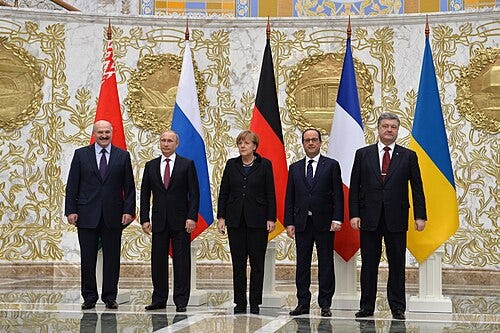
Putin then fell for deceitful Merkel and Hollande, by making efforts to get the Minsk II accords implemented. It was only years later, in 2021, that Russia reacted to the new president Zelensky’s threats to march on Crimea and to escalate the war in Donbass, by amassing troops on its own side of the border.
The question therefore needs to be asked: could the Ukraine conflict and all the Russian military victims have been largely avoided if Moscow had put its diplomatic and perhaps even its military fist down much earlier and more clearly? Putin has himself hinted at this. Considering the above, this question certainly cannot be disregarded and should be addressed by future historians.
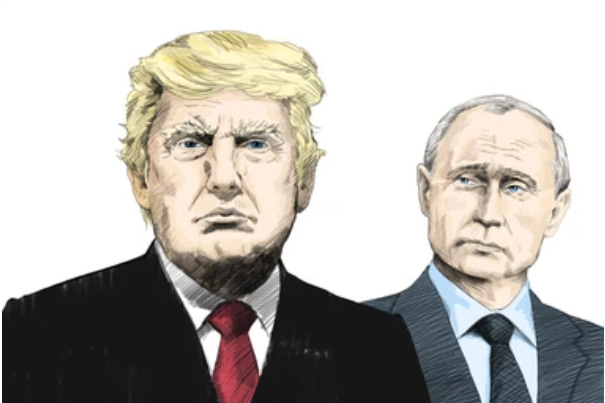
In the Valdai Conference in Sochi of 2025, Putin stressed, a little surprisingly, that good relations with the US are his main and the Russian state’s foremost consideration in foreign affairs. On the one hand, the US is not only the biggest potential threat to Russia, and a “huge” nuclear power, as Trump likes to point out. But on the other hand, peace in Eurasia and friendly relations with all Russia’s neighbors ought perhaps to be higher on the agenda for Moscow. Putin thus again showed to what extent he wants Russia to be liked by the West, and by Washington in particular. Yet, this is the same West that he on the 24th of Feb 2022 called the “Empire of Lies”…
Frozen Talks in Alaska
Washington bears responsibility for hundreds of civilian Russian deaths, and tens of thousands of Russian soldiers’ deaths, with its arms shipments, its financial help, its surveillance assistance and logistical support to Kiev. Without the deep support of the United States, the conflict in Ukraine would most likely have been over in 2022.
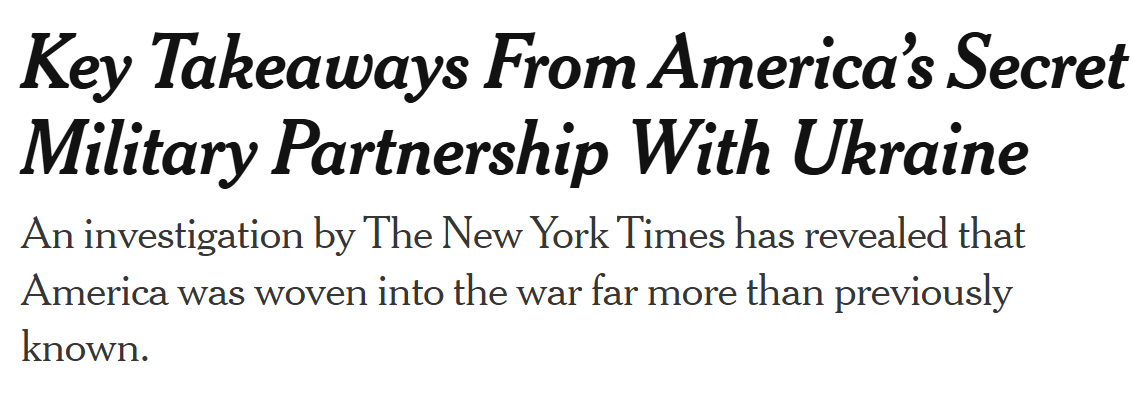
It should therefore be intolerable and unacceptable to Russia that Trump is positioning himself and the US as a mediator in the Ukraine-Russia conflict. How dare he? Not only is this war now “his” war (not Biden’s), but the US is controlling Ukraine completely. As the NYT explained, the Ukraine war is being essentially run strategically by US generals out of the NATO base in Wiesbaden, Germany.
Seen in this light, it is shocking to see Putin accepting to play this role, smiling in Alaska, in the charade of Trump and the US as a “mediator” in the conflict. Is it really necessary for Putin then to help Trump uphold this illusion of the USA as the peace broker between two warring parties? What does it signal to Trump? To the Russian public?
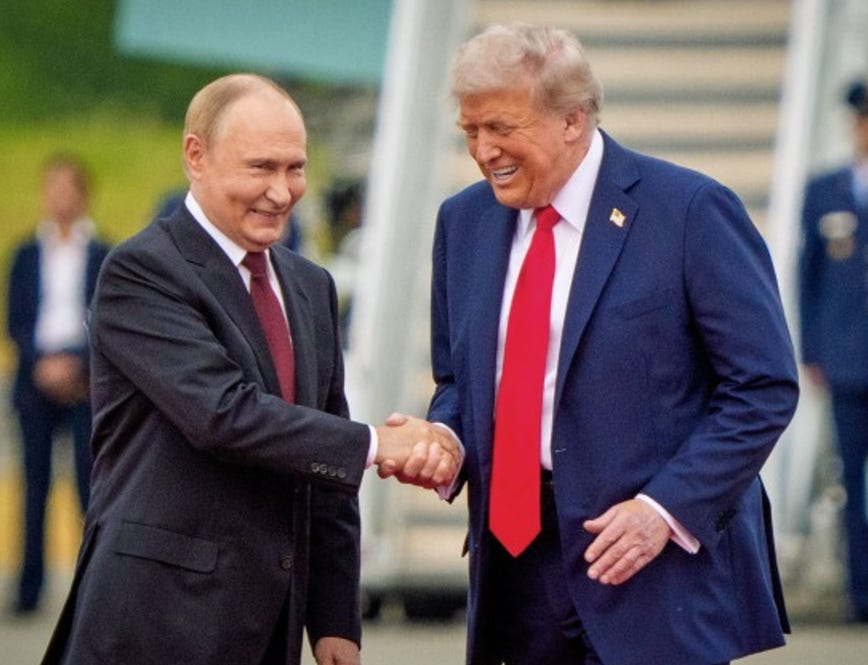
It was in August 2025 that Trump sent Witkoff to see Putin in Moscow to beg for a summit meeting, as he was under pressure from the Senate to impose sanctions. Putin accepted to meet in Alaska after Witkoff proposed a peace settlement: essentially the Istanbul April 2022 draft agreement between Russia and Ukraine, with a freezing of the conflict on the contact line in Zaporozhe and Kherson oblasts. But in Anchorage, Trump reneged on his promise, prefering to first consult with allies (EU and Ukraine).
In hindsight, Putin should probably not have gone Alaska. His decision to do so can probably be explained, again, by his rosy view of the United States and Trump. But it also hints at something more serious: Putin is overestimating the real power of the US President to decide alone even in foreign policy, in particular when this decision goes against the wishes of the Deep State, meaning IC, MIC, Pentagon, State, etc. It is easy to recall how Obama was rebuffed when he wanted to close the Guantanamo Bay facility or how Trump was rebuffed when he wanted to bring US troops back from Afghanistan during his first term.
Yet, strangely enough, it seems that the Russian leadership thought that a meeting in Alaska with Trump was all it would take agree on the thorny Ukraine issue. Putin still does not seem to understand after all these years how Washington works. The US is “agreement-incapable” and cannot be trusted under any circumstance, which is something many Russians now know.
It is possible to mention yet another Putin mistake with respect to Trump. He publicly announced the successful testing of two powerful nuclear-powered weapons; the “Poseidon” underwater mega-torpedo and a new cruise missile, the “Burevestnik”.
This announcement was hardly necessary from Putin, and certainly not at this tense moment. It could predictably only have led to a negative reaction from the country with which he claims to want to have good relations. Indeed, Trump reacted in true character, thin-skinned as he is, but seeming not to understand the nature of the new Russian weapons: he ordered a restart of real nuclear weapons testing. This is of course not at all in Russia’s interest and obviously not the reaction from Washington that the Kremlin expected.
All the President’s Men
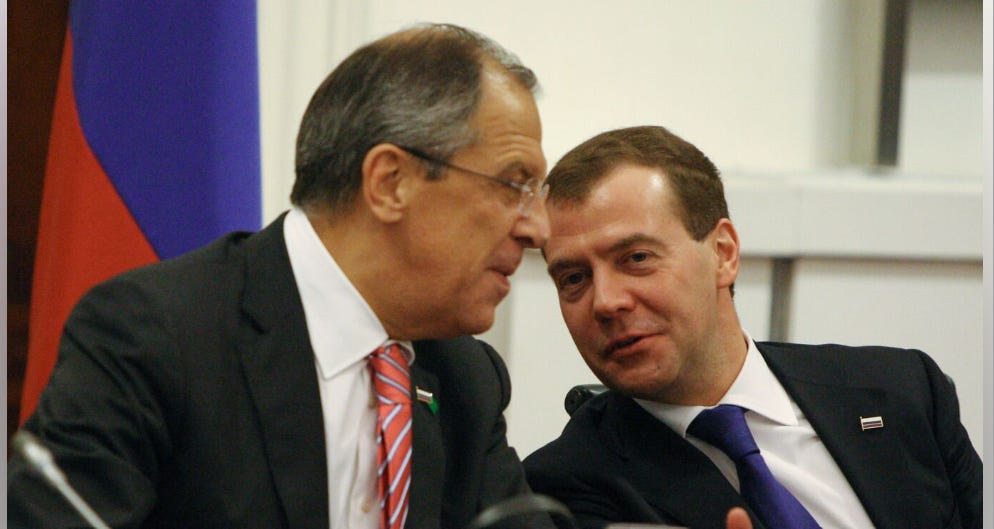
Notwithstanding Trump’s irascible and irratic personality, Putin could please him less and also anger him less. It seems that he has difficulty keeping a stable middle ground of “serious deference” to Washington. Arguably, there are those in Moscow who better understand the positioning that is necessary with respect to the US: Medvedev, Ryabkov and Lavrov come to mind. These three gentlemen seem to grasp the true nature of US foreign policy better than Putin himself and his aides Ushakov and Dmitriev. This is at least an impression that an outsider gets now.
Putin now needs to consider his next steps with the USA very carefully, avoiding the missteps of the past, in the upcoming diplomatic and political dance around Ukraine, not only to safeguard Russia’s interest, but to maintain the support of domestic public opinion. As Yves Smith of nakedcapitalism.com wrote:
“Polls and the tone of commentary support the idea that Russian citizens more and more favor aggressive prosecution of the conflict, and subduing/controlling all of Ukraine and thus have been frustrated with Putin’s dalliances with Trump.”
Already in 2024 if not earlier, Sergey Lavrov, Russia’s most senior diplomat, stated that the conflict in Ukraine would be settled on the battlefield if the root causes of the conflict were not considered. This should constantly be the lode star for the Russian stance with the West, without making overtures to Washington that are only perceived as weakness, like Putin and Dmitriev have done. Indeed, it is for the Western powers, those responsible for this conflict in the first place, to reach out to Moscow - not the other way around. This may happen soon, as the Ukrainian army is finally starting to collapse; there are early signs of this now.
Despite the fact that the above analysis is based only on public sources, and that there are thus many unconsidered unknowns, a pattern anyway emerges. It is the image of a president Putin who sometimes seems a little too accepting and gullible towards the West, and in particular towards Washington. It is difficult not to draw the conclusion that Putin was far too passive all these years, despite obvious US aggressiveness in Russia’s own “near abroad”.
Russia will still win the Ukraine conflict against NATO; such is the domination of the Russian forces on the battlefield now, and such is the discipline, the strategy and the innovation that has been implemented by the Russian General Staff. But Putin and his aides need to get their act together and make less foreign relations mistakes with respect to treacherous US politicians, or he runs the risk of accepting a peace settlement that could prove to be frustrating and unsatisfactory for Russia in the long run.
No comments:
Post a Comment