
Yet, the current political context, which can be summarized as a US fuite en avant (forward flight) as Eurasia rises, is clearly creating tensions between the US and the rest of this collective West. As the analyst Kautilya eloquently writes: “What once appeared as a unified Western coalition is now fragmenting under the weight of conflicting interests, diverging threat perceptions, institutional corruption and strategic exhaustion.”
Washington - from Protector to Vampire to Predator
It is important to understand that the current geopolitical crisis in the world has one single focal point: Washington DC. The question is no longer whether US power is in decline, but how. The French Historian Emmanuel Todd made the prescient point in his 2002 work, After the Empire: The Breakdown of the American Order, that the United States, as it declines, does not withdraw, but rather becomes more demanding and parasitical towards its allies. Like a vampire, the “imperial center” thrives by draining the capital, talent, and energy of its “periphery” (Europe, Japan, etc.) in order to maintain and even grow its consumption-fueled and debt-based economy.
Examples of such policies are the Inflation Reduction Act, the added tribute from the vassals in the form of US weapon purchases, and the blowing up of Northstream II gas pipelines, which all have redirected investments and increased US competitiveness at the expense of European economies.
For many reasons, financial, domestic and geopolitical, US is now in a more serious stage of decline, in line with Todd’s recent work, The Defeat of the West (2024). It is a darker and more desperate phase, in which US behavior is focused on preventing systemic collapse. It is a predatory behavior towards not only its vassals, illustrated with the following ugly examples: US planning to snatch Greenland from the Danes, threatening further tariffs on Europeans (but which actually hurt US consumers), kneecapping European energy policy, supporting genocide in Gaza, and trying to enact regime change in Iran.

This explains the tensions currently arising between the US and Europe as the latter is very belatedly waking up to a US foreign policy that has actually been aggressive and lawless for decades. Europe has consented to ride the coattails of countless US foreign wars, getting some of the crumbs, and continues to do so today, as the recent events in Gaza, Iran, Syria and Venezuela show. As long as US imperialism is not directed at them, the actions of the United States has generally not bothered the European ruling minority, as they have continued to deceitfully pay lip service to the fuzzy concept of “rules-based international order” - not to the UN Charter.
The United States still needs Europe, as is clear from the recent US National Security Strategy, which demands “burden sharing”. The NSS states: “We will need a strong Europe to help us successfully compete, and to work in concert with us to prevent any adversary from dominating Europe.” In other words, Europe is expected to continue antigonizing Russia, so the US can focus on China and disengage just in time from yet another disastrous foreign war, leaving hundreds of thousands of young Ukrainian soldiers dead and wounded, with the Europeans to foot the bill financially and politically.
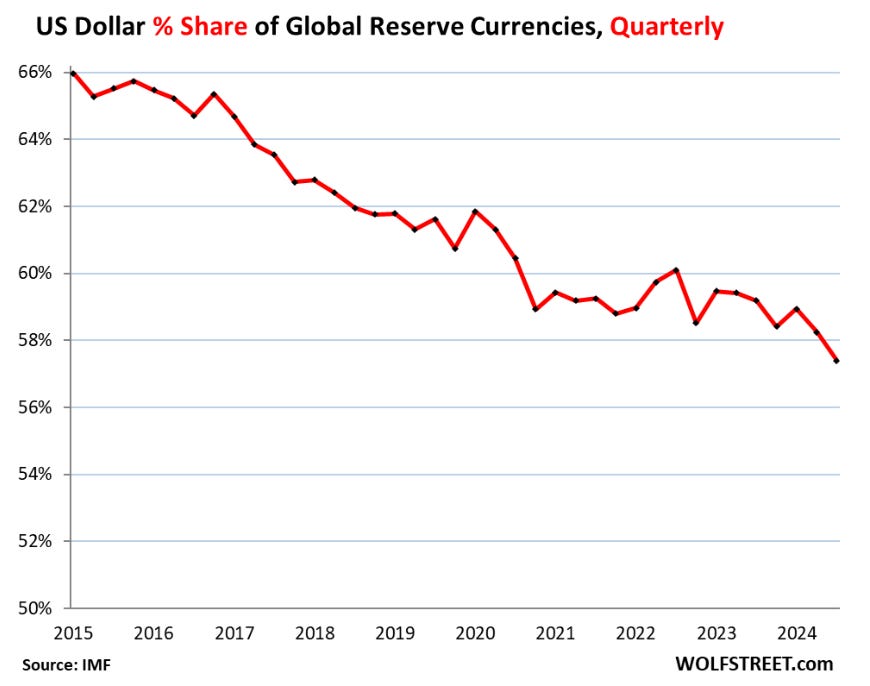
The new predatory foreign policy is of course also related to the absolute necessity, from a US perspective, of keeping the US dollar as world reserve currency. The dollar is a key pillar of US power and must be maintained at all costs, dixit Trump.
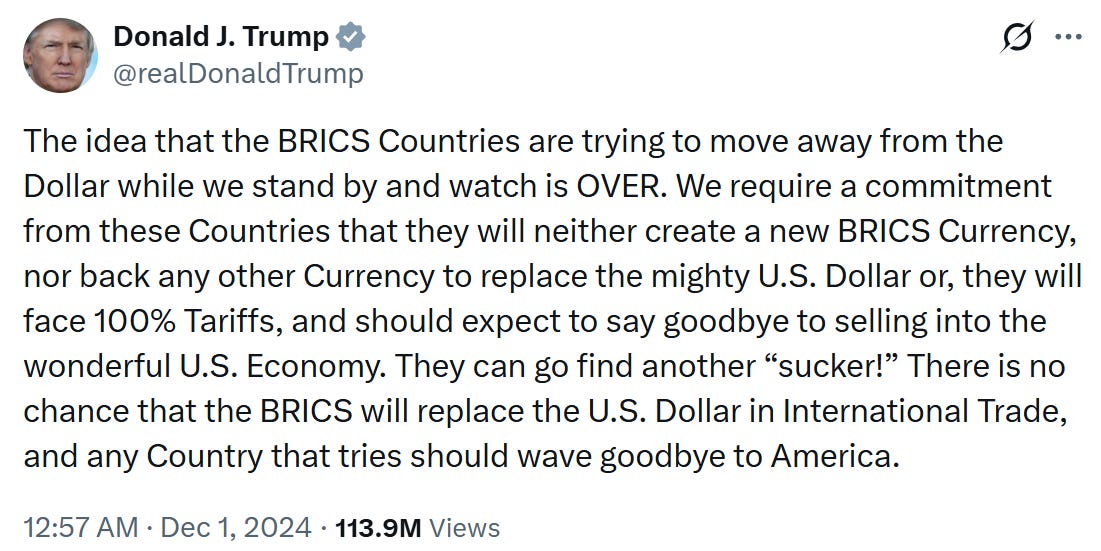
For instance, Venezuela, just like previously Iraq (2003) and Libya (2011), had chosen another currency than the dollar for its oil, which probably was yet a reason for the military aggression again this country.
The United States in a Race Against Time
Journalist Thomas Fazi gets is right when he describes this current US foreign policy:
“For all his rhetoric about ending “forever wars”, Trump continues to embrace a fundamentally supremacist vision of America’s role in the world — albeit a more pragmatic one than that of the liberal-imperialist establishment. […] Trump’s policies toward China, Iran and the broader Middle East confirm that Washington still sees itself as an empire whose global dominance must be preserved at all costs — not only through economic pressure, but also through military confrontation when deemed necessary.”
Further, statements from US officials and Washington policy documents make it clear that behind the rapid-fire foreign policy of the Trump administration is an acute sense in Washington that the US in a race against time to preserve this global dominance". It is not unusual for dominant powers that feel threatened to react in this way, as researcher Nel Bonilla wrote: “The feeling of time running out is not a novelty in imperial statecraft, but it is once again the principal accelerant.”
The phenomenon is also typical for the very “Western” character of the USA; it exists in the left hemisphere not only geographically but also psychologically, as the political thinker Kevin Batcho writes:
“The U.S. approach, particularly under Trump, reflects the left hemisphere’s temporal orientation: compressed, immediate, and transactional. Left-hemisphere thinking seeks resolution in the present, measuring success by rapid, concrete outcomes rather than coherence over time.”
The implication, of course, is that the other side, notably Russia and China, have time on their side, not only geopolitically, as the slow attrition of Ukraine and the slow dedollarization process make clear, but also psycho-culturally. Indeed, Washington has an inkling that it cannot reasonably prevail over the long term against China, let alone over a Eurasian or BRICS alliance. Thus, as Bonilla writes that:
The goal is “not to win in any decisive sense, but to win time: to keep the attrition plateau intact until some outside relief (a technological leap, a rival’s crisis) restores room to maneuver. It is governance by delay.”
Europe - From Happy Vassals to Miserable Slaves
For Europe, the dilemma is different, because it has a longer and more complex History. It is not in a race against time for domination, since its societies have already been brought down several notches in the last century, through the largely self-inflicted catastrophes of WWI and WWII, as well as through their statist and low growth economic policy.
The current bluster from the European political class is therefore mostly a sign of their fear, frustration and powerlessness towards the new predatory US. The political communication that these incompetent but smooth leaders engage in is simply done to limit the damage of the current debacle to their reputations and future careers.
Despite fundamental differences presented above between the US and Europe, there is still far more that ties them together than separates them, even though the Europeans may no longer be “happy vassals”. There is no serious split between the US and Europe, simply because it is not in their interest, despite Trump testing the transatlantic relationship to the limit. Lady Europe, like a scorned and submissive wife to Uncle Sam, is not about to leave her tormenter and would-be protector. At least the current batch of European leaders won’t have to swallow their pride; they have none.
No comments:
Post a Comment