
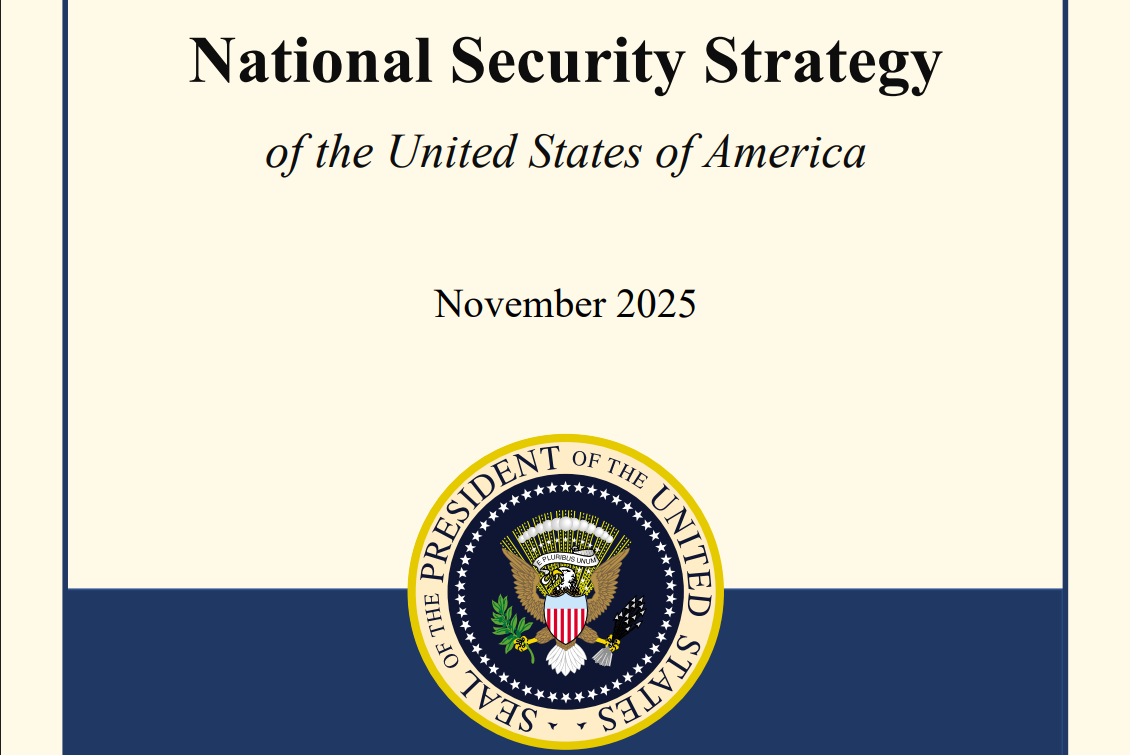
When the latest US National Security Strategy document came out, many analysts in Europe saw this as a confirmation that the US under the Trump administration is concerned about Europe, wants to support Europe, and selfishly wants Europe to succeed. Regardless of whether this NSS will represent US foreign policy and whether this NSS will actually be implemented, both of which are far for certain, this view of Washington from Europe must be cynically and clearly debunked.
“I Want to Be Loved by You”
It seems so many Europeans still just want to be loved by the USA, by their “daddy”, to quote NATO Sec. Gen. Mark Rutte. They grasp at any opportunity to confirm this view, as soon as they think they detect an inkling of consideration from Washington. The latest NSS could, superficially, give this feeling. Indeed, it contains the following quotes in the section on Europe:
“We want to support our allies in preserving the freedom and security of Europe, while restoring Europe’s civilizational self-confidence and Western identity”
“We want Europe to remain European, to regain its civilizational self-confidence, and to abandon its failed focus on regulatory suffocation.”
“It is a core interest of the United States to negotiate an expeditious cessation of hostilities in Ukraine, in order to stabilize European economies.”
“Encouraging Europe to take action to combat mercantilist overcapacity, technological theft, cyber espionage, and other hostile economic practices.”
“Europe remains strategically and culturally vital to the United States”
Washington “Cultivating resistance to Europe’s current trajectory within European nations”
“Certain NATO members will become majority non-European. As such, it is an open question whether they will view their place in the world »
“Our goal should be to help Europe correct its current trajectory.”
Yet, these lines should not be seen as the United States caring about Europe, but only as caring for its own interests, which should not be surprising for any observer of international relations. The US cannot afford a weak Europe; it is not in its strategic interest, in particular in a world in which the Global South, and the rest of humanity, is slowly turning away from it.
US Responsibility for Europe’s Woes
But why is Europe is such a sorry state, politically, economically and socially? Of course, a lot has to do with its own statist policies over decades, and the bloated bureaucracies that are throttling overregulated and overtaxed European economies. Can the US really save Europe from that, even if it wanted to? Doubtful to say the least…
But more to the point, when the NSS states that “Europe is weak and is experiencing civilizational erasure”, it is essential to remember that the US has also played an important role in creating these major European crises in the first place. For example:
The US encouraged, and then never opposed, the process of centralization of power in Bruxelles (EU, NATO) over many decades, instead of respecting the decentralization of power that is natural for the European continent. Henry Kissinger mockingly asked: “Who Do I Call, When I Want to Call Europe?”, implicitly suggesting that Europe should become federal like the US, against the wishes of its citizens.
The Great Recession of 2008 was recklessly triggered by the US financial oligarchy after having benefitted for years of a low-interest regime and the Ponzi-scheme-like CDOs. The impact on European economies was significant, though probably unintentional from the US side.
The US, in its megalomanic post-Cold War frenzy, went to war and pushed for regime changes in Afghanistan, Syria, Libya and Iraq, which directly lead to the mass-immigration crises in Europe over the last fifteen years, with huge social and economic costs to European nations.
Biden’s $3 trillion Inflation Reduction Act, with its substantial green-tech subsidies and “made in America” requirements, has helped lure investments away from Europe and undercut its industries. The EU responded with its own “Green Deal” to maintain competitiveness, though not being nearly equivalent.
The US Justice Dprt. uses the concept of “extraterritoriality” of US law, forcing fines of billions of USD from European companies for not respecting the FCPA and Washington’s own unilateral and illegal sanctions world-wide.
The Ukraine conflict was instigated over many years by the US in order to try to weaken Russia, without one thought for the larger long-term consequences for Europe, whose political class enthusiastically decided to go along with such a harebrained plan.
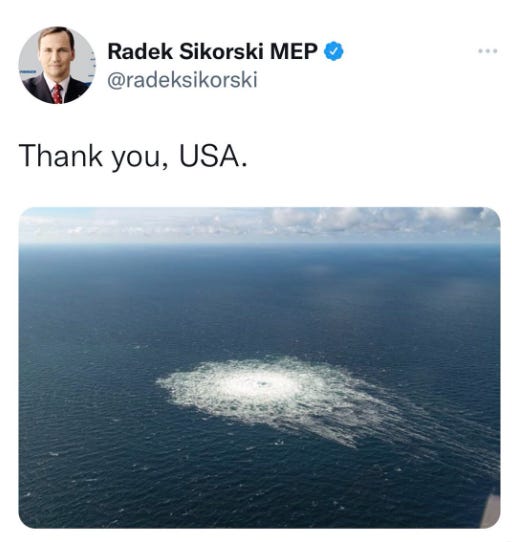
The US most likely blew up the North Stream II gas pipeline in 2022, thereby helping to dramatically increase European energy prices, rendering European (German) industry uncompetitive, and inciting European companies to set up shop in the US.
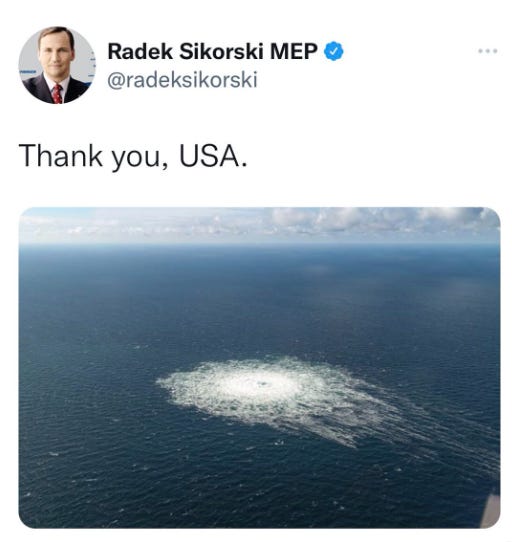
Great communication skills by the Polish FM
These policies, if not all frankly anti-European, were against the interests of European nations. The direct and indirect costs for these policies are significant. The US has been able to avoid major push-back from Europe because of an “Atlanticist” European political class that is reluctant to criticize Washington for anything. Again, the role of the incompetent but also treacherous and submissive European political leadership should not be underestimated in order to explain the rapid decline of the Old Continent.
It’s All About “Burden Sharing”
Prof. Jeffery Sachs wrote that the NSS shows US “treating other nations as instruments to be manipulated for American advantage.” A more politically correct way of expressing this is the key phrase in the NSS : “burden sharing”. The United States needs Europe as a lord needs his vassal. The Europeans are expected to be strong “allies” to the US in Western Eurasia.
In the immediate term, Washington wants Europe to share the burden of the Ukraine conflict so that the US can concentrate on escalating tensions with China. This will also allow the US to avoid most of the blame for the looming defeat of NATO by Russia, or so they think. As the NSS confirms:
“We will need a strong Europe to help us successfully compete, and to work in concert with us to prevent any adversary from dominating Europe.”
It doesn’t take a genius to see that the “adversary” meant here is Russia, which remains a key opponent for the US. This is close to the Wolfowitz doctrine from 1992, for which the “first objective is to prevent the reemergence of a new rival” in Eurasia.

But it is worth remembering that this “burden sharing” concept is not new; it has just become more urgent. For instance, intelligence gathering has partly been a shared effort with European allies for years. In Afghanistan and Iraq, European nations played a substantial role in the US “war on terror”. They accounted for at least 30,000 soldiers in Afghanistan and the UK contributed with 40,000 soldiers during the 2003 invasion of Iraq, with continued presence afterwards.
In this sense as well the NSS of 2025 is “continuity of agenda”, regardless of who is in the White House. Because the balance of power is shifting in the world, Washington needs even more now from its European vassals, which is why it strongly suggests that European states need to get their act together. In the NSS, Washington is now concerned that the Europeans aren’t strong enough to fulfil their “assigned” role:
“It is far from obvious whether certain European countries will have economies and militaries strong enough to remain reliable allies”.
They are worried the European vassal states cannot pay tribute to the Yankee lord in the form 5% of GDP spending mostly going into the Military-Industrial Complex (“from mid-2022 to mid-2023, 63% of the EU defence contracts were awarded to US companies”). The commercial nature of the US empire is exposed so clearly here, when the investment target is set first, without bothering much with the actual defense procurement strategy.
Echoes of the Marshall Plan
This US expressed need today for a strong Europe recalls the thinking around the Marshall Plan after WWII, during which the United States from 1948 financed European reconstruction and defense mainly to assure ideological and strategic loyalty.
[With the Marshall Plan], the United States secured a strategically loyal bloc of allies for the emerging Cold War order; an ally that would accept and follow all their instructions and impositions, because their economic stability was now dependent on the American willingness to continue funding their post-war rebuilding.
Then like now, European are also expected to orient their geostrategy and their economies towards the US and contribute by opening for business for American companies, as the latest NSS confirms:
“Opening European markets to U.S. goods and services and ensuring fair treatment of U.S. workers and businesses”.
This is a long-standing US priority, not specific to this NSS or the current administration: to gain more access to European markets that have not always been open to US investments because of national or EU regulations. Many European sectors and companies are seen as strategic, mouth-watering targets for US firms.
Despite being constantly humiliated publicly by the US, the Europeans will do what they are told by Washington, out of habit, admiration, necessity and confusion. It seems that the US can treat Europe with utter disdain and still get submission. Hesitation and antipathy towards Trump specifically could maybe light a spark of resistance from the feckless European leaders, but there is hardly much sign of that.
The US has used Europe for decades and plans to continue to do so. At a minimum, Europeans should understand this. To think that one’s exploiter is actually one’s caretaker is not only faulty thinking but also a strategic blunder. It shows how deep Europe’s delusion goes regarding the United States. Europe now urgently needs to grasp its new upcoming role in the world and rebalance its relationship not only with the US, but also with the Global South.
No comments:
Post a Comment