
PRC and ROC could solve the “Taiwan issue” by ushering in the official end of Communism in China.
All political problems have a solution, however intractable. This is exactly the case with the “Taiwan issue” and the possible reunification of the two Chinas (PRC and ROC). Such solutions should be sought since the Taiwan Strait could become the next flashpoint, if the United States insists on full spectrum dominance.
China and Taiwan could reunite by 2049, if not before, with both sides making concessions to the other and if the US agrees. Both PRC and ROC have political and economic incentives for this to happen. A weakened USA might accept reunification if it could claim the “defeat” of Communist China, a “regime change” in Beijing, without firing a shot. Washington might seize a face-saving off-ramp offered by China, in order to normalize relations with Beijing and thus, however grudgingly, de facto accept China’s inevitable global leadership.
The political disagreement over Taiwan is smaller than it would seem at first glance. For the PRC there is only “one China”. The UN and 184 nations also see PRC, not ROC, as China; among them the US. As a reminder, the “one-China principle” is the official position of the United States, through the three China-US joint communiqués from 1972, 1978 and 1982:
“The United States of America recognized the Government of the People’s Republic of China as the sole legal Government of China, and it acknowledged the Chinese position that there is but one China and Taiwan is part of China.”
What the Polls Say
The key point then becomes the opinion polls, especially in Taiwan. Any successful, i.e. stable, long-lasting and unchallenged, reunification of Taiwan with China must take into account popular opinion on both sides of the Strait. Regarding sentiments in China, two Taiwanese media state the following about Chinese public:
“while the Chinese government continues to emphasize “reunification” in official discourse, the public’s appetite for resolution via military force is waning.” and
“Chinese public hold relatively friendly sentiments towards Taiwan. The majority of respondents favor non-military means to improve cross-strait relations, with 86% supporting strengthened cultural exchanges and 81% believing in deepening economic and trade interactions.”
Regarding sentiments in Taiwan, the Taiwanese DPP (pro-independence) government’s poll estimates that regarding the Taiwanese:
“more than 80% of respondents (81.2%) disagree with the CCP’s “one country, two systems” proposition, while nearly 70% (68.9%) support maintaining Taiwan’s status quo and reject unification with the CCP.”
Over the long term, the attitudes regarding reunification have not changed much in Taiwan:
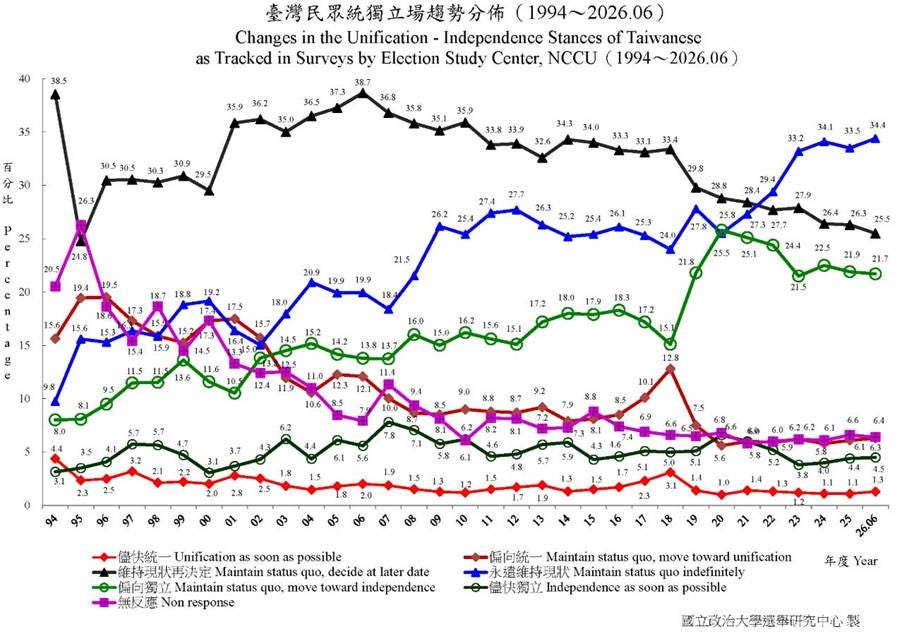
It is clear from this poll that a majority of the population of Taiwan, over 85% of Taiwanese, want “status quo”, probably because they are wary of “rocking the boat” in one direction or the other. If they were sure that their lives would not change upon reunification with the mainland, resistance could drop.
The US Cannot Defend Taiwan
As the US is fast weakening through its own actions, the balance of power is shifting in the East Asia. The US cannot defend Taiwan. Over the coming years, the United States will face military limitations, strategic decline, internal turmoil, and financial difficulties. The lack of will and capacity of US military power is already clear, as the US “prefers” to grapple – mostly unsuccessfully - with regional or local powers such as Iran, Venezuela, or Cuba, rather the face off directly with a peer competitor like China.

Tellingly, the US never finally pivoted to Asia, as was planned over 15 years ago during the Obama presidency. The United States has preferred to be distracted elsewhere, against Russia and for Israel, as its industrial-military capacity is falling behind Beijing’s in both size and capability.

Taiwanese leadership and society are waking up to a reality in which military reliance on Washington is an untenable strategy, just as Saudi Arabia is learning this lesson the hard way. Recognizing that Washington cannot and will not defend Taiwan against a nuclear-armed military and technological behemoth, Taipei’s strategic calculus will naturally turn away from military defense and confrontation, toward pragmatic engagement with Beijing and cross-strait rapprochement. This would simply be a political alignment with economic reality (approx. 30% of Taiwan’s exports go to China).
China Ditches Communism
To render the absorption of Taiwan palatable to Washington, and not to ruffle Western feathers generally, Beijing could make a sophisticated ideological transformation. The PRC’s official adherence to traditional Marxist-Leninist and Maoist rhetoric should be formally and officially set aside in favor of the broader civilizational-state narrative that is already beginning to take shape.
In reality, anyone looking at the development of the Chinese economy understands that it is not a Marxist-Leninist development at all. Official Communist ideology in China has already for a long time been secondary to the market economy and the idea of national revival; the “rejuvenation” of China as Xi Jinping calls it, echoing the founder of Taiwan’s Kuomingtan, Sun Yatsen (1866-1925).


There is an obvious equivalence here with the end of the Soviet Union, which led to Marxist-Leninism being replaced in Russia with the Nationalism of the Russian Federation. The PRC could probably abandon Mao, Marx and Engels more easily than the West thinks. China was never really as ideological as Europe, including Russia. The pragmatism and practicality of China’s Confucian tradition make it weak on ideological conviction. Moreover, most of Chinese life today is so different compared to the premises of Maoist teachings for revolutionary peasants, that it becomes almost embarrassing and nonsensical to continue to refer to this ideology at each Party Congress of the CCP.
Most Chinese today are not devoted ideologues but materialistic money-lovers. Though this is often criticized in China, it indicates a sane capitalist instinct grounded in reality. That is more than can be said of many ideological snowflakes and warmongering crusaders in the West today, in particular in the political class.
Reunification Under the ROC Flag
In a grand gesture of political compromise, Beijing could officially shed Communism and adopt the ROC name, flag, and constitutional legacy. Similarly, Russia replaced the hammer and sickle with the Tsarist tricolor in 1992. The ROC flag can serve as a unifying symbol for both PRC and ROC, since it resonates historically in both Beijing and Taipei.
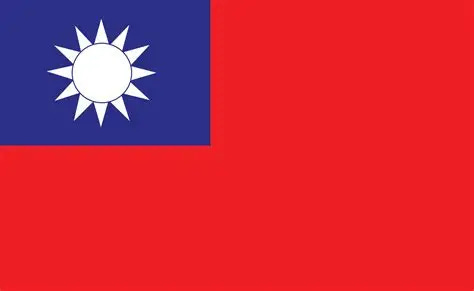
The ROC flag originated with Sun Yat-sen’s revolutionary movement and became associated with Chinese nationalism and national unification. Ironically, because it symbolizes Chinese unity rather than Taiwanese independence, the flag has at times found defenders in the PRC itself.
Sun Yat-sen’s “Three Principles of the People” consisted of nationalism, democracy, and people’s welfare. These themes are close to the contemporary PRC. As a result, ROC symbolism could provide Beijing with a face-saving mechanism to frame reunification not as a CCP takeover of Taiwan, but as the completion of the unfinished Chinese 1911 Revolution and the restoration of national unity.
A Typical Chinese Solution: Surface Covers Substance
On the surface, this concession would appear to be a historic Taiwanese victory. The political identity represented by the ROC would seemingly prevail over that of the PRC. Yet the demographic and economic imbalance between the two sides is so overwhelming that reunification would still result in China’s political and economic absorption of Taiwan.
Any constitutional changes introduced by Beijing would likely be limited and largely cosmetic. Effective control over state institutions, foreign policy, defense, and strategic decision-making would remain concentrated in Beijing. Taiwan would gain symbolic prestige and substantial autonomy while becoming integrated into a broader Chinese political framework.
Internationally, this would amount to a masterful diplomatic feint. By formally retiring Communist symbolism and embracing a constitutional tradition associated with Sun Yat-sen, Beijing could neutralize many of the ideological arguments traditionally used by Western governments against China. The appearance would be one of democratic and national reconciliation rather than geopolitical consolidation.
For Washington, this could provide a politically acceptable off-ramp. A reunification process presented as the abandonment of Communism might be portrayed domestically as a strategic victory rather than a defeat. The United States could claim that decades of pressure ultimately transformed China, even if the underlying balance of power continued shifting in Beijing’s favor.
Neutralizing US Opposition to Reunification
The economic incentives to accept such a settlement could be considerable. Expanded access to Chinese markets and products would be attractive to Western economies. At the same time, Beijing would likely need to reassure Washington regarding Taiwan’s strategic and technological importance, particularly concerning TSMC’s semiconductor production.
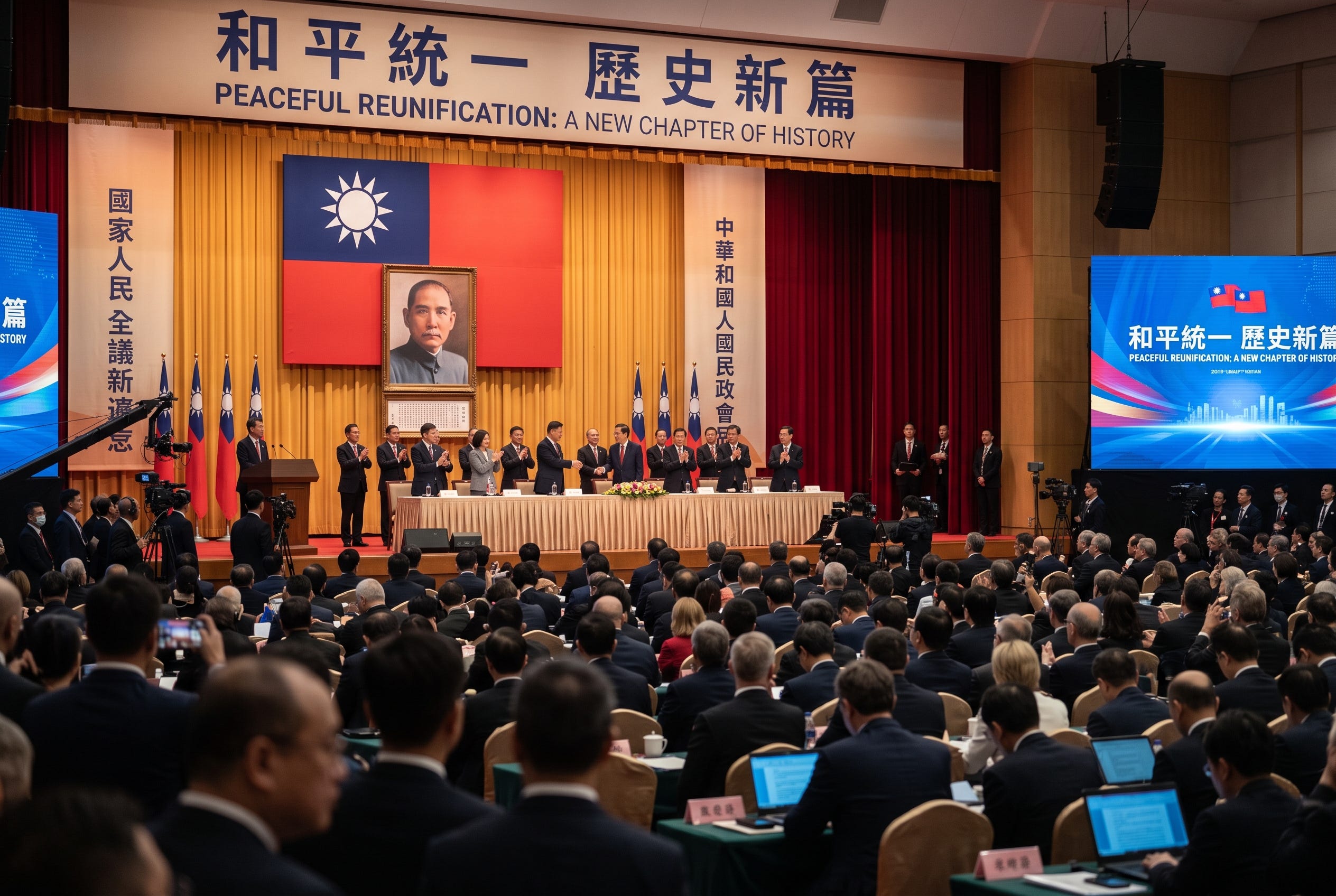
If these concerns were addressed and reunification were publicly endorsed by leaders on both sides of the Strait and accepted by a clear majority of Taiwanese, opposition in the West would become increasingly difficult to sustain. The agreement would be presented internationally as a diplomatic triumph ending a long-standing historical dispute without war.
By yielding on symbolism while retaining substance, Beijing could achieve its long-standing objective of national integration, perhaps by 2049 or earlier. For China, symbolic concessions would be a small price to pay for peaceful reunification. For Taiwan, everyday political life could continue largely unchanged for decades, while gaining even greater access to Chinese markets and technologies.
In such a scenario, Taiwan could claim to have fulfilled Chiang Kai-shek’s dream of seeing all China governed under the banner of the Republic of China. Yet the practical result would be integration into a China governed from Beijing. Such an outcome would demonstrate once again that mastery of diplomacy and symbolism can often achieve what military force cannot.
No comments:
Post a Comment